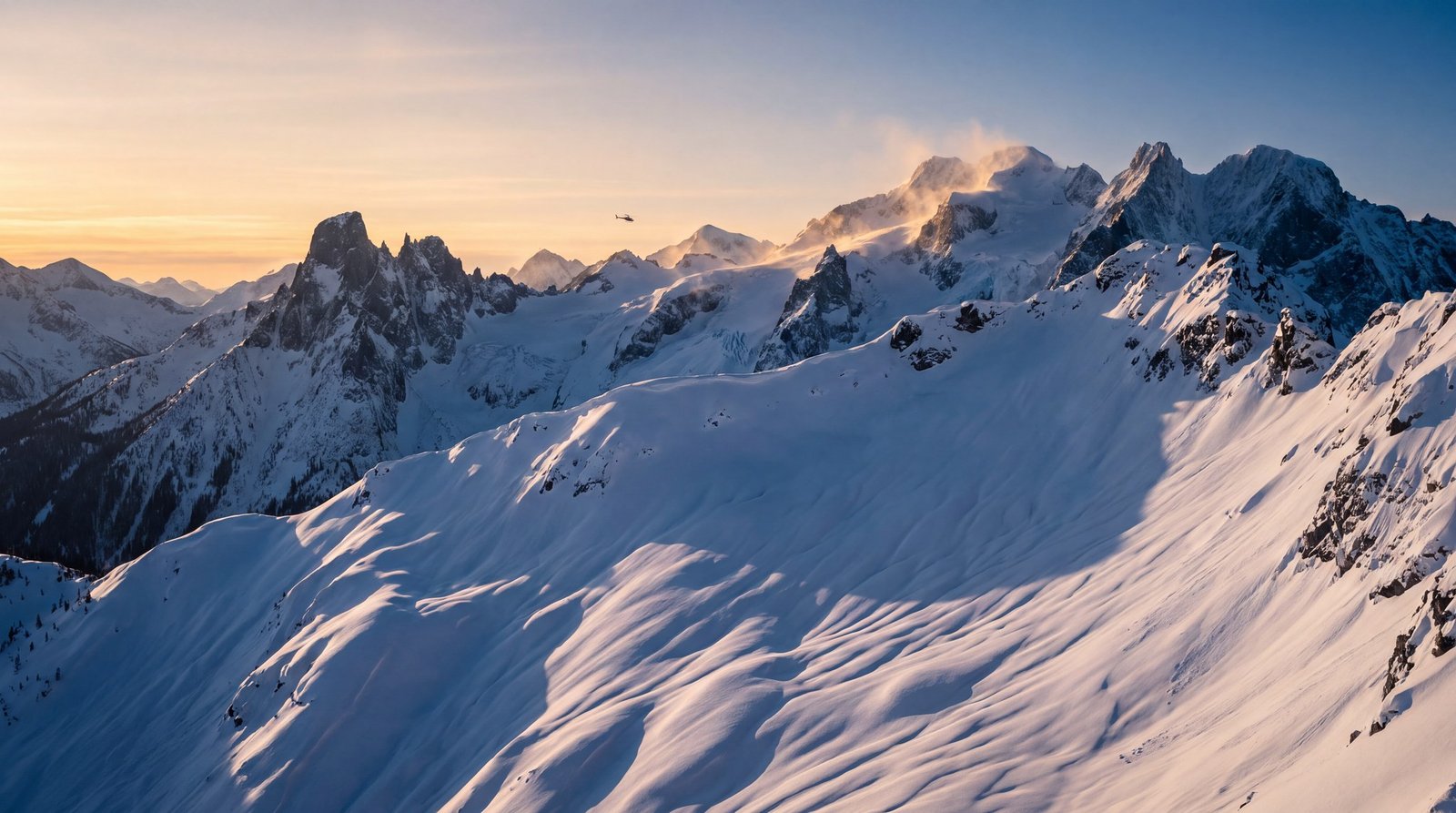
The thing that changes between your first heli run and your fifth is the silence. On the first run, you're focused on the snow — on keeping your tips up, on reading the pitch, on the fact that this slope exists in a range with no lifts and no trail markers and no other skiers anywhere in view. By the fifth run you've stopped cataloguing the absence of resort infrastructure and started hearing the mountain itself: the compression of snow under your skis, the wind at the ridgeline, the helicopter somewhere above you already repositioning for the next group.
Heli-skiing is not a ski trip with an upgrade. It is a fundamentally different relationship with mountain terrain — one that has no resort analogue and that cannot be approximated by any combination of early-morning powder hunting at a regular ski area. The terrain is wilder, the snow is deeper, the guides are operating in ranges they know intimately over careers that span decades, and the days accumulate vertical footage that would be physically impossible to achieve any other way. A good week in British Columbia means 100,000 feet of vertical skiing. Some weeks more.
Getting it right requires honest thinking about what you can ski, where you want to go, who you want to go with, and what you're willing to accept from the weather. This piece is for that conversation.
What a day actually looks like
The morning starts early, with weather and snowpack conditions reviewed by the guides over breakfast. This is not a formality — the morning briefing determines where the helicopter flies and which terrain opens. On a settled, high-pressure day, the entire tenure of the operation's licensed range is available. On a storm day or a day with elevated avalanche risk, the guides pull back to lower-angle tree skiing. On a day with clouds sitting on the peaks, you may not fly at all.
Assuming conditions are right: guests are divided into groups of ten to twelve, each paired with two guides. The groupings are based on ability assessed on the first run — fast groups go first and ski steeper terrain at higher pace; slower groups ski at a more deliberate rhythm with terrain selected accordingly. The guides do this assessment honestly, and the groups are adjusted after the first morning if the initial placement isn't right. Ego is a liability in this process.
Each run begins at the helicopter landing zone — a saddle or ridge or open summit where the aircraft sets down briefly, blades spinning, while guests exit with equipment and move uphill a few paces to clear the rotor wash. The guide reads the slope, calls a line, and drops in first. The group follows. Depending on the run length — typically 600 to 1,200 meters of vertical — the descent takes five to fifteen minutes. At the bottom, the helicopter has already repositioned and is waiting. You load, lift off, and climb to the next drop point. A good day logs eight to fourteen runs.
Lunch happens in the field — packed by the lodge kitchen and eaten wherever the guides find a wind-protected spot, usually a flat section mid-mountain with a view that makes the stop feel earned. In the afternoon, the energy in the group shifts. Legs that were fresh in the morning are functioning on something closer to determination. This is when the skiing gets interesting, because fatigue clarifies what technique actually is.
Back at the lodge by late afternoon. Ski equipment goes into the boot room. The sauna runs hot. Dinner is family-style, at communal tables, with wine on the table and food that is considerably better than the physical location of the kitchen would suggest.
British Columbia — why it's where you start
Canadian Mountain Holidays, founded in 1965 in the Bugaboos range of the Purcell Mountains, created commercial heli-skiing as a category and remains the standard against which other operations are measured. CMH operates eleven lodges across ranges that collectively cover over 2.3 million acres of permitted terrain — the Bugaboos, Bobbie Burns, Cariboos, Monashees, Galena, and others — each with its own terrain character and snow profile.
The Bugaboos are the most dramatic: granite spires rising above glacial runs, steep couloirs, and the specific combination of exposure and vertical that makes the range one of the most photographed mountain environments in the world. The Monashees, farther west, receive some of the heaviest snowfall in BC and are the deep-powder terrain — tree skiing through old-growth forests with snow depths that can reach the guides' waists in a good January week. The Cariboos sit between them in character: varied, consistent, and well-suited to intermediate groups where ability levels are mixed.
Mike Wiegele Helicopter Skiing, based out of Blue River in the Monashee and Cariboo ranges, is the other BC operation worth knowing. Smaller than CMH — one lodge, more focused group sizes — and with a reputation for powder depth that is hard to overstate in a strong La Niña winter. For guests who have already done CMH and want a different character of operation, Wiegele is the right conversation.
The other destinations
British Columbia is the logical starting point for most heli-ski guests, but it is not the only context worth understanding.
Alaska — the Chugach and Tordrillo Mountains — is a different category of terrain. The ranges outside Valdez and in the Tordrillo system southwest of Anchorage are steeper, bigger, and less forgiving than anything in BC. The lines that Alaskan operations run — thousand-meter faces at angles that require genuine commitment — attract a specific type of skier who has exhausted the intermediate challenges of Canadian operations and wants the objective exposure of working in consequence terrain. It is not a first heli-ski experience. For the right client, it is the definitive one.
Norway and Greenland offer ski-to-sea descents in the Lyngen Alps and Svalbard that are categorically different from North American heli-skiing — not about accumulated vertical but about skiing from a mountain summit directly to a fjord, with the Arctic light and the specific drama of descending into open water on a horizon with no development in any direction. The season is short and the weather window is narrow, but the geography is unrepeatable.
Japan — Hokkaido is a separate conversation entirely. The powder that falls on the ranges around Niseko and in the northern ranges of Hokkaido is the lightest, coldest snow in any major skiing region — a consequence of weather systems coming off Siberia over the Sea of Japan. Heli operations here are more modest in scale than BC, the vertical is lower, but the snow quality in January and February is something that BC regulars consistently describe as a different substance. For skiers who care primarily about what the snow feels like, Hokkaido deserves serious consideration.
Southern Hemisphere options — the Andes in Chile and Argentina, the Southern Alps in New Zealand — exist for those with inflexible Northern Hemisphere schedules or who want to ski in June through August. Quality varies more than in BC; the right operations are excellent, and the wrong ones are worth avoiding. The guidance matters here.
The physical reality — what you need to be able to ski
This is the section that matters most for anyone who hasn't done it before.
Heli-skiing in British Columbia does not require expert skiing ability in the strictest sense, but it requires a specific kind of skiing competence that is harder to define than a simple level rating. You need to be able to ski varied terrain — steep, flat, variable snow conditions — without hesitation, without needing to stop and compose yourself, and without planting your poles to initiate turns. You need to be able to ski powder. These two requirements eliminate a substantial portion of people who are otherwise confident intermediate skiers.
Powder skiing technique is genuinely different from groomed skiing. On hardpack, weighting the downhill ski is efficient and correct. In deep powder, the skis need to plane as a pair — weight distributed evenly, stance wider, rhythm slower, patience through the compression at the bottom of the turn. Skiers who learned entirely on groomed terrain and have spent fewer than ten to fifteen days in off-piste snow often discover that the technique they rely on doesn't translate. This is not a reason not to go — it is a reason to spend two or three days skiing off-piste at a resort before your heli week, so that you arrive with some powder muscle memory already functional.
The fitness requirement is real and underestimated. You are skiing more vertical in a single day than most resort skiers cover in a long weekend. The cold and the altitude — most drops are between 1,800 and 2,800 meters — add fatigue that doesn't appear in advance planning. Arriving in strong cardiovascular condition changes the quality of the third and fourth day significantly.
Avalanche safety — the briefing and what you carry
Every guest receives an avalanche safety briefing before the first day of skiing and is required to carry an avalanche transceiver (beacon), probe, and shovel throughout the operation. The guides carry these as well and are certified in avalanche rescue. This is not performative safety protocol — it is the operating condition of skiing in terrain that has not been controlled, patrolled, or inspected before you drop into it.
CMH and other reputable operations maintain rigorous snowpack monitoring, employ certified avalanche forecasters, and make conservative terrain decisions when conditions warrant. A significant portion of the apparent conservatism — the days when the guides pull back to trees, the runs that are passed over in favor of safer alternatives — is the direct reason the industry's safety record is what it is over six decades of operation. The protocols are not obstacles to the experience. They are the reason the experience is possible at the scale it operates.
First-time heli-ski guests are sometimes surprised by how seriously the guides take a declined run or a closed zone. The answer to "why aren't we skiing that face?" is always the same: the guides have been reading this snowpack for years and the answer this morning is no. That judgment is the product the operation is actually selling, more than the helicopter.
The lodge — what being remote actually means
CMH lodges are accessible only by helicopter. There is no road in, no town nearby, no option to drive to a restaurant or leave early without coordination. For seven nights you are in the company of roughly forty guests and a staff that has arranged everything within a relatively small perimeter of wilderness buildings — the main lodge, the guest rooms, the boot room, the sauna, and the mountain outside.
The social dynamic of a heli-ski lodge is unlike hotel travel in the usual sense. You eat every meal with the same people, you ski with a subset of them every day, and by day three you know more about your fellow guests than you typically learn from people you've traveled alongside for a week. This works because the shared context — the runs, the weather days, the cumulative exhaustion, the dinner conversation that begins with "did you see that line off the north ridge?" — produces an unusually compressed form of social bond. Group travel clients report this as one of the unexpected aspects of the experience.
The food at CMH lodges is taken seriously in a way that remote wilderness logistics don't make easy. Fresh produce comes in by helicopter on supply runs. The kitchen produces multi-course dinners, the wine list is curated to a reasonable cellar depth, and the breakfast and lunch spreads are designed for people who have burned several thousand calories and are about to do it again. After a week, the meals become part of the rhythm of the place.
The weather days — the honest section
You will likely have at least one day during a seven-day booking when flying is not possible or significantly curtailed. Mountain weather in BC is not managed by anyone. A weather system that moves in overnight can shut the helicopter down for a full day or limit flying to lower terrain in the trees. This is not a flaw in the operation — it is the operating reality of being in the mountains in winter.
CMH addresses this through a vertical guarantee: if you don't ski a minimum amount of vertical footage over your week, they credit the difference toward a future booking. The specific terms vary and should be understood before you book. The broader point is that experienced heli-skiers plan for and accept weather days as part of the product. A weather day at the lodge — sauna, books, conversations with guides about terrain and snowpack and history — is not a wasted day. It is the day you understand that what you're doing is genuinely dependent on conditions you don't control, which is exactly the thing that makes the flying days feel the way they do.
First-time guests sometimes struggle with this more than the skiing itself. The expectation management conversation before the trip matters.
Booking — lead times and what to know
CMH opens bookings for the following season in late spring or early summer, and prime weeks — February and early March, which are statistically the most reliable for both snow and weather — fill within days of opening. The waitlist is active and does move; cancellations happen as the season approaches and guests make plans. But planning to book a prime February week fewer than six months in advance is planning to be on the waitlist.
Pricing for a seven-night CMH lodge package runs from approximately $12,000 to $17,000 USD per person depending on lodge, week, and room category — inclusive of all meals, guiding, helicopter time, and equipment storage. It does not include airfare to the nearest regional airport, gear, or gratuity. For groups, lodge buyouts are available that convert the operation into a private booking; the economics and social dynamics of a private week are significantly different and worth understanding if you're planning for ten or more guests.
Single skiers and small groups book into the general lodge population. This works well — the mix of guests at any given week is typically experienced, self-selecting, and there for the same reason you are.