The Glacier Express, End to End: What the Train Actually Is
Zermatt to St. Moritz in eight hours. 291 bridges, 91 tunnels, and one of the most deliberate rail journeys on earth. Here is what the experience is — and why direction and class both matter more than most travelers realize.
Mark SoleFounder & Travel Director, Hit Your Mark Travel
Share
JourneyGlacier Express
RouteZermatt → St. Moritz (eastbound)
When to GoOctober — autumn foliage season, and the version we recommend
Duration7.5–8 hours
Class to BookExcellence Class — the dedicated front car added in 2022, four-person bays, forward-facing panoramic window
Best ForCouples, Switzerland itineraries, rail enthusiasts, October foliage
Not Right ForTravelers on tight schedules; anyone expecting a fast or action-dense day
The Glacier Express is not the Orient Express. This distinction requires stating because the two trains are frequently confused in the imagination of travelers who haven't been on either. The Orient Express is a nostalgia product — a restored historical train that moves slowly between European cities while serving elaborate meals in period compartments, functioning as a hotel experience that happens to move. The Glacier Express is an operational Swiss railway that has been running through the Alps since 1930 and continues to function as a scheduled service connecting Zermatt, Andermatt, and Chur to St. Moritz.
What it is not is fast. The standard rail connection between the two endpoints would take roughly three hours by road. The Glacier Express takes eight. The entire point of the journey — the reason it exists as a travel experience rather than a mere transportation solution — is those extra five hours. They are spent climbing passes that exceed 2,000 meters, crossing 291 bridges, passing through 91 tunnels, and moving through terrain that no road network adequately replicates. The slowness is the product.
"The Swiss have optimized many things, and the Glacier Express is one of them. What they have not done is made it fast — and that is entirely the point. Eight hours to cover what a car could manage in three is not inefficiency. It is a different relationship with the landscape."
Direction and why it matters
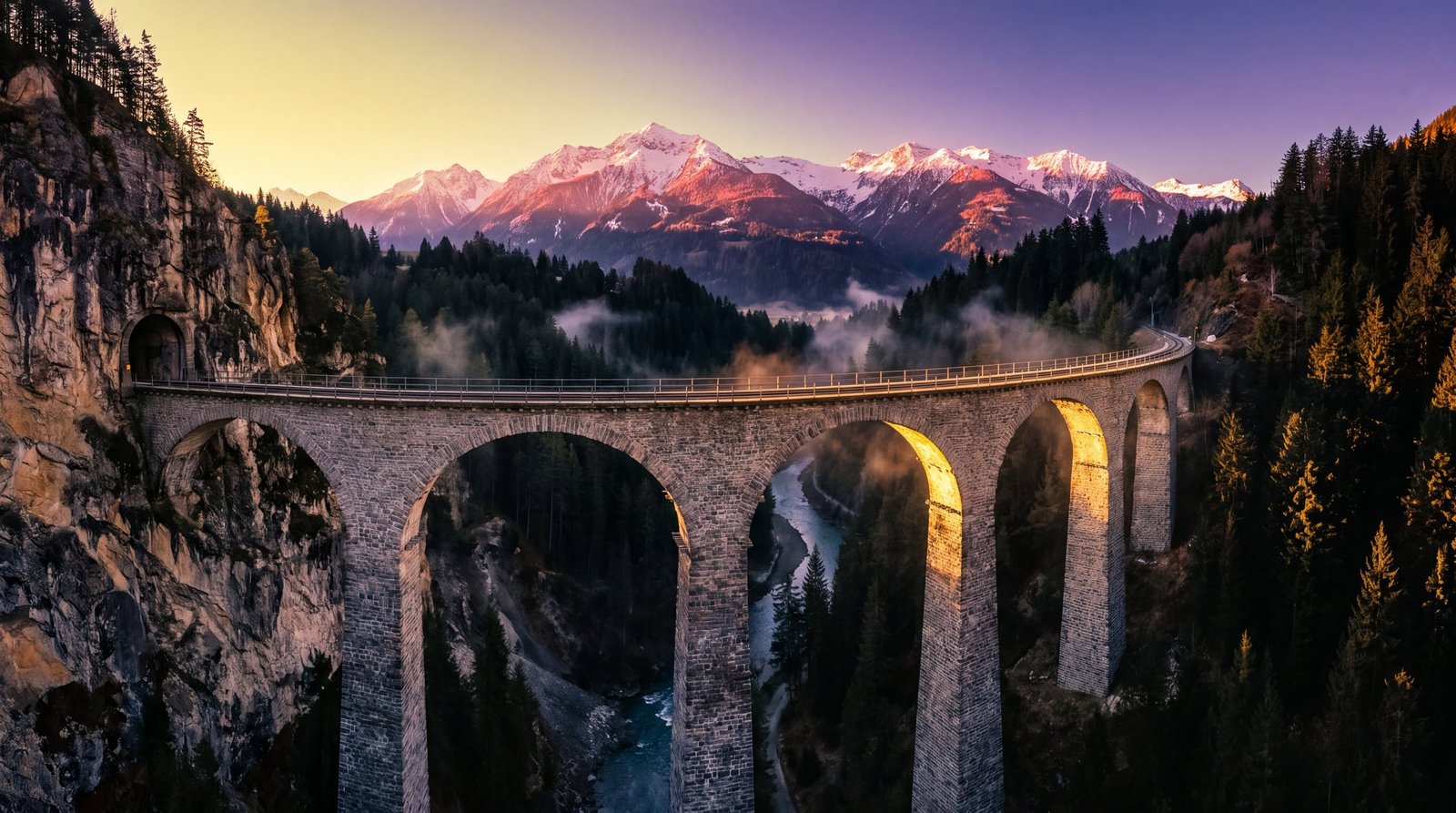
The Glacier Express runs in both directions daily, and the choice of direction is more consequential than most travel articles suggest. Running eastbound — Zermatt to St. Moritz — puts the Matterhorn behind you at departure and the Engadine valley ahead of you at arrival, with the Landwasser Viaduct appearing as the journey's visual climax in the late afternoon light approximately ninety minutes before St. Moritz. This is the better direction.
The westbound run — St. Moritz to Zermatt — arrives into Zermatt in the late afternoon with the Matterhorn available as the journey's endpoint. For travelers who have not seen the Matterhorn and want the emotional impact of arrival in Zermatt, this has appeal. For travelers who are departing Zermatt and continuing east, the eastbound route is better composed: you depart the most dramatic mountain and spend eight hours descending in narrative from that point toward a different landscape.
There is a practical consideration as well: the Landwasser Viaduct — a 65-meter-high curved stone railway bridge that emerges from a tunnel and arcs directly into the face of a cliff — is one of the most photographed railway structures in Europe, and it appears at a position in the journey that, running eastbound in October, falls in good afternoon light. Running westbound, you pass it in the morning when the light is behind the cliff face. Eastbound is correct.
Excellence Class
The Excellence Class is the premium product on the Glacier Express, added in 2022 and occupying a single dedicated car at the front of the train. It offers dedicated four-person seating bays with a panoramic view forward through the driver's cab window, a dedicated host, a four-course meal service (included in the fare), Swiss wines from the trolley, and a level of service that the standard First Class does not replicate.
The forward-facing panoramic window is the practical differentiator. In standard First Class, you see the landscape through the side panoramic windows — excellent, but lateral. In Excellence Class, the forward window gives you the track ahead disappearing into tunnels, cresting passes, emerging from rock cuts into open valley. For a journey defined by its landscapes, seeing where you are going rather than where you have been is materially different.
The meal service in Excellence Class is notably good for a train — four courses, Swiss ingredients, properly plated, with wine pairings available. This matters because the eight-hour journey requires a full midday meal, and the alternative in standard First Class is the dining car queue, which on a popular summer or autumn day can be a significant wait. Excellence Class serves you at your seat. On a journey that benefits from not standing up unnecessarily, this is not a trivial distinction.
The route, section by section
Zermatt to Visp (1 hour): The departure from Zermatt at 8:52am clears the Matterhorn vista within the first twenty minutes. The narrow valley descent to Visp, where the Glacier Express joins the main Rhône Valley line briefly before turning east, runs through high alpine terrain at gradient angles that require rack-and-pinion assistance on certain sections. The light in October is already golden at this hour.
Visp to Andermatt via the Furka Base Tunnel (2 hours): The original Glacier Express route ran over the Furka Pass, one of the highest road passes in the Alps, and the journey included a mountain crest crossing at 2,165 meters that was closed each winter. The Furka Base Tunnel, completed in 1982, runs beneath the pass and keeps the train running year-round. In summer, the historic Dampfbahn Furka-Bergstrecke steam railway still operates over the old route as a heritage attraction; the Glacier Express no longer goes above the pass. Andermatt, where the train pauses, is a valley town that has been substantially developed in recent years with a Aman resort and ski infrastructure.
Andermatt to Disentis via the Oberalp Pass (1.5 hours): This is the journey's highest point. The Oberalp Pass at 2,033 meters is the only true mountain pass the current Glacier Express crosses, and the ascent from Andermatt is gradual and panoramic. In October, the larch trees along this section have turned amber and gold, and the combination of high alpine meadow, distant snowline, and autumn color is the most photographically rewarding stretch of the entire route.
Disentis to Chur (1 hour): The Rhine Gorge descent from Disentis to Chur is dramatic and underappreciated. The Rhine Gorge — sometimes called the Swiss Grand Canyon — is a limestone canyon carved by the Rhine through the Graubünden mountains, and the railway runs along its edge for a sustained stretch. The light in October catches the gorge walls in the early afternoon at the right angle.
Chur to St. Moritz via the Albula Line (2.5 hours): The Albula Line is the journey's technical and visual climax. A UNESCO World Heritage railway in its own right, it climbs from Chur's valley floor to the Engadine plateau through a series of spiral tunnels and viaducts that gain altitude in a geography that would otherwise prohibit it. The Landwasser Viaduct appears approximately thirty minutes south of Filisur, and the train crosses it at reduced speed — long enough to register the drop below the bridge deck and the cliff face it emerges into.
October specifically
October runs the Glacier Express at the end of the autumn season, after the peak summer crowds and before the winter ski traffic begins. The train carries fewer passengers than in July or August, which means Excellence Class berths are available with less advance notice, the dining car queues in standard First are shorter, and the platform transitions at Andermatt and Chur are less crowded.
The visual case for October is the larch forests. Larches are deciduous conifers, unusual in the Alps, and they turn a vivid amber-gold in mid to late October. The Oberalp Pass section and the upper Albula Valley sections run through larch forest that, in late October, is at the peak of its autumn color. The combination of snow on the upper peaks, golden larch forests in the middle elevations, and green valley floors in the lower sections produces a vertical layering of color that simply doesn't exist in summer.
Before and after
The journey works best as a connector within a broader Switzerland itinerary rather than as a standalone day trip. Zermatt rewards at least two nights before departure — the hiking and the Matterhorn views are the point of being there, and a one-night stay barely permits orientation. St. Moritz offers a night in the Engadine before continuing east toward Italy or south toward Milan.
The train works well in both directions as part of a larger Swiss loop: Geneva or Zurich entry, a few days in the Bernese Oberland or Valais, Zermatt, the Glacier Express to St. Moritz, then either south to Lugano and Italy or north to Zurich for departure. Building it as a transit day — a beautiful movement from one region to another — is more satisfying than treating it as a destination in itself.
How we build this into itineraries
We build the Glacier Express as a centerpiece transit day within Switzerland itineraries — a day that moves you from one region to another while being substantive in itself. Excellence Class reservations require advance booking (the car fills quickly in October), and we handle seat selection to maximize the forward and right-side views for the key sections. If you are planning a Switzerland trip, contact us to discuss where the train fits in the broader route.
Fitting the Route Into a Trip
Eight hours of train is a spine, not an itinerary. The route is usually hung off a longer Europe trip, and the Alpine section pairs cleanly with northern Italy at either end of it.
I've run the Glacier Express in both directions across different seasons. The October eastbound Excellence Class version is the one I recommend without qualification. The direction and class decisions are genuinely consequential — this piece is the version I give clients before they ask.