Borobudur at dawn. A private pool facing two volcanoes. A staff-to-guest ratio that makes the phrase "dedicated service" finally mean something specific. Here is what the experience actually is — and what it isn't.
Mark SoleFounder & Travel Director, Hit Your Mark Travel
Share
PropertyAmanjiwo
LocationBorobudur, Central Java, Indonesia
When to GoMay–October dry season — the most reliable window for the dawn access
Nights We BookThree, inside a wider Java or Indonesia itinerary
Room to BookDalem Jiwo Suite — the most secluded of the thirty-six
Best ForCouples, cultural immersion, architecture travelers
Not Right ForFamilies with young children; travelers seeking beach or activity programming
The Aman question is always the same: is it worth it? The rates are extraordinary. The brand occupies a category of its own — not merely expensive but definitionally at the top of the market, in a price bracket that prompts travelers who otherwise never question a hotel spend to pause and recalculate. The answer, at Amanjiwo, is yes. But understanding why requires understanding what Aman is actually selling.
Aman is not selling rooms. It is selling the specific experience of arriving somewhere and having everything unnecessary already removed. The check-in desk does not exist. The lobby does not exist in the conventional hotel sense. There is no crowd at the elevator, because there is no elevator, because the thirty-six suites are arranged around a hillside in a configuration that gives every guest the impression of having the property to themselves. The ratio of staff to guests typically exceeds two to one. None of this is visible or announced. It is simply the condition you find yourself in, and it takes a day to calibrate to.
"The Aman philosophy — more staff than guests, spaces designed around absence rather than presence, the deliberate removal of anything that doesn't need to be there — is either the most sophisticated hospitality model on earth or a very expensive version of nothing, depending on what you're seeking. At Amanjiwo, it is the former."
The property and its setting
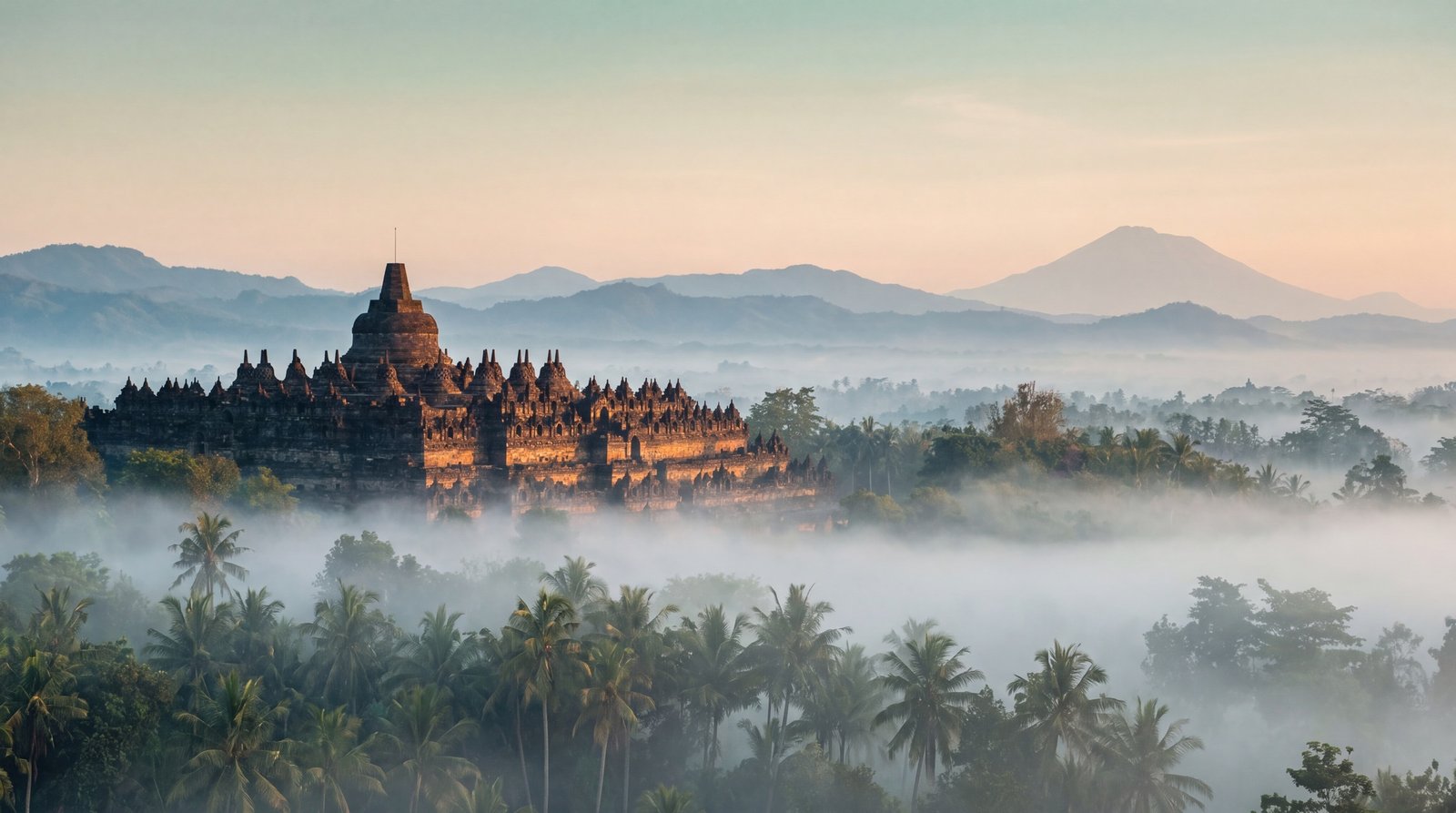
Amanjiwo sits on a hillside in Central Java, one and a half kilometers from Borobudur — the largest Buddhist monument in the world, a ninth-century stupa complex that is Indonesia's most significant archaeological site. The property was designed by the architect Ed Tuttle, who built several Aman properties and developed a visual language that draws from Javanese temple architecture without replicating it. The main rotunda is built from grey andesite, the same volcanic stone as Borobudur itself. The suites are arranged in cascading terraces around the bowl of a hillside, each with an unobstructed view of either the monument or the two volcanoes — Gunung Merapi and Gunung Merbabu — visible to the north.
The Dalem Jiwo Suite is the most secluded room category, positioned at the furthest reach of the property on a private terrace. The suite has an outdoor bathtub that opens to the garden, a private pool that faces the volcanoes at the right angle to catch the sunrise, and a living room that opens on three sides to the surrounding landscape. Set against the other suites in the same price bracket, the Dalem Jiwo is better designed than most of them.
Borobudur at dawn
Amanjiwo holds a preferred access arrangement with the Borobudur management authority that permits guests to enter the monument before the public opening at the first light of dawn — typically 5:15am, depending on season. This access is the central reason to stay at Amanjiwo rather than any other property in the area, and it is worth understanding what it means in practice.
Dawn at Borobudur with fifteen other Aman guests is a fundamentally different experience from the standard daytime visit with several thousand Indonesian and international tourists. The monument in the early light — the sky moving from dark blue to gold, the mist still in the valley below the terraces, the distant volcanoes coming into definition behind the upper stupas — is one of the genuinely affecting visual experiences available anywhere in Southeast Asia. Clients who are hard to impress come back saying exactly that. The property exists in large part to provide access to this moment, and it delivers it.
The Aman guide who accompanies the dawn visit has an architectural and religious depth that transforms the experience from a photography walk into an actual understanding of what the monument is and why it was built. Borobudur is a three-dimensional mandala — a cosmological diagram in stone, designed to be walked as a form of meditation — and this reading of the site is not apparent from the structure alone. The context makes the physical experience legible in a way it otherwise isn't.
The service — specifically
The thing Aman gets right that other luxury hotel chains approximate but do not achieve is staff memory without visible effort. By the second morning, coffee arrives without being ordered, in the configuration you specified the first morning, at the time you incidentally established by being on the terrace. This is not magic — it is information management and staff briefing — but the experience of it is the absence of friction, which is what distinguishes Aman hospitality from properties that describe their service as "anticipatory" without producing the actual thing.
The staff at Amanjiwo are Javanese, almost without exception, and the cultural register is different from the corporate polish of international luxury chains. The interactions are warm rather than formal, unhurried rather than efficient. The question "Is there anything else you need?" is not asked. It is answered before it arises.
The food and the cooking class
The open-air dining pavilion at Amanjiwo serves Javanese and Indonesian cooking alongside Western options, and the quality exceeds what the remote location would suggest is achievable. The nasi campur — the Javanese mixed rice plate with its collection of small preparations — is produced at a level most Indonesian restaurants do not reach. The spice work is specific and regional, not generalized.
The cooking class offered through the activity program involves a morning trip to the Borobudur market with a guide, followed by preparation of a Javanese meal in the property kitchen. This is worth booking regardless of your interest in cooking. The market visit is the better half of the experience: a working wet market in a small Javanese town with a guide who buys from the same vendors his family has used for decades. It is the kind of access that does not come from walking through a destination on your own.
What Aman doesn't provide
Amanjiwo has no beach, no significant spa programming, no organized activity calendar of the kind that resort properties build to occupy guests. The pool is beautiful and quiet. There is a spa with a small treatment menu. Beyond the Borobudur access and the cultural activities organized through the concierge, the property offers space, silence, and aesthetic quality. That is what it is for.
Travelers who need programming — who want a full menu of activities, a kids' club, a beach bar, organized entertainment — will find Amanjiwo under-stimulating. The property is specifically designed for people who find all of that exhausting, and who want a place where the quality of nothing-happening is extraordinary. This is not a universal preference.
Amanjiwo is also not the right choice as a standalone destination. We build it as two or three nights within a broader Java or Indonesia itinerary — combined with Ubud in Bali, or a cultural route through Yogyakarta, or a broader Indonesia trip that includes the Komodo region or Raja Ampat. As a beginning or ending point for a larger journey, it is one of the finest places to spend three days anywhere in Southeast Asia.
Who it's right for
Couples, specifically. Design-conscious travelers who respond to architecture and place. Anyone building an Indonesia itinerary that includes Central Java. Travelers who have been to Bali many times and want to understand the depth of Javanese culture rather than the Bali version. People who value quiet and quality above programming and stimulation.
It is wrong for families with children under twelve, who will not engage with the Borobudur experience at the level that justifies the surrounding cost. It is wrong for travelers who primarily want a beach. It is wrong for anyone who needs an activity-dense trip to feel that they have used the time well. For everyone else, it is close to irreplaceable.
Advisor Note
Amanjiwo is in our preferred partner network. We build Java itineraries that use the property as an anchor — typically three nights, with the dawn Borobudur access as the central experience, combined with a private cultural program through Yogyakarta. Contact us to discuss timing; the dry season (May through October) is the most reliable for the dawn experience.
Planning Around Borobudur
Amanjiwo sits in Central Java, and most itineraries that reach it pair the temple half with the island next door. Bali and Indonesia planning covers how the two halves fit together and which order works better in practice.
If the draw is the temple rather than the pool, culture and history travel covers how the guide side of a trip like this gets built.
About the Author
Mark Sole
Founder & Travel Director
The Aman portfolio is one I recommend selectively — not every traveler is the right fit, and the rate requires that the fit be correct. Amanjiwo remains one of the clearest cases I know for why the price premium exists and what it actually produces.