The conventional advice is to visit the Mediterranean in June or September. June is warm and not yet peak. September is when the summer crowds begin to thin. Both months are reasonable. Neither is the best option — and the reason most people land on them is that the travel calendar is written by people who have not actually compared September to October on the ground.
September in Positano still has gridlock on the coastal road. September in Santorini still has a photography backlog at the caldera sunset viewpoints. September rates at the better properties in Tuscany and the Amalfi Coast are still within a few percentage points of August rates, because demand hasn't dropped yet and the hotels know it. The season transitions more slowly than the calendar suggests.
October is different. October is when the transition actually arrives. The German school holidays are over. The American families who pushed their trips into September have gone home. The boutique hotels have room. And the Mediterranean — which spent four months absorbing solar energy — has sea temperatures that remain comfortably swimmable through the end of the month. You are not trading the water. You are trading the crowds.
What October actually delivers
The October case rests on four things working together. First, the heat is gone. July and August in southern Italy, Greece, and Turkey routinely produce 35–38°C midday temperatures that push travelers indoors from noon to four. In October, daytime highs run 22–26°C across most of the region — warm enough for outdoor meals at any hour, cool enough to actually walk cities and cover archaeological sites without planning around shade.
Second, the water is still warm. The Mediterranean and Aegean hold warmth from four months of summer into October, typically running 22–24°C through mid-October in most of the region. This is meaningfully warmer than northern European summer destinations and warmer than the Atlantic coast of Spain and Portugal. If swimming or water activities are part of the trip, October does not require a sacrifice.
Third, harvest season is underway in Italy and France. Truffle season opens in Tuscany and Umbria in October. The wine harvest runs through the month in Chianti, Barolo, and the regions of southern Italy. Olive harvest in Puglia begins in late October. This is not ambient atmosphere — it is active, visible, and participable. The countryside in October is doing something.
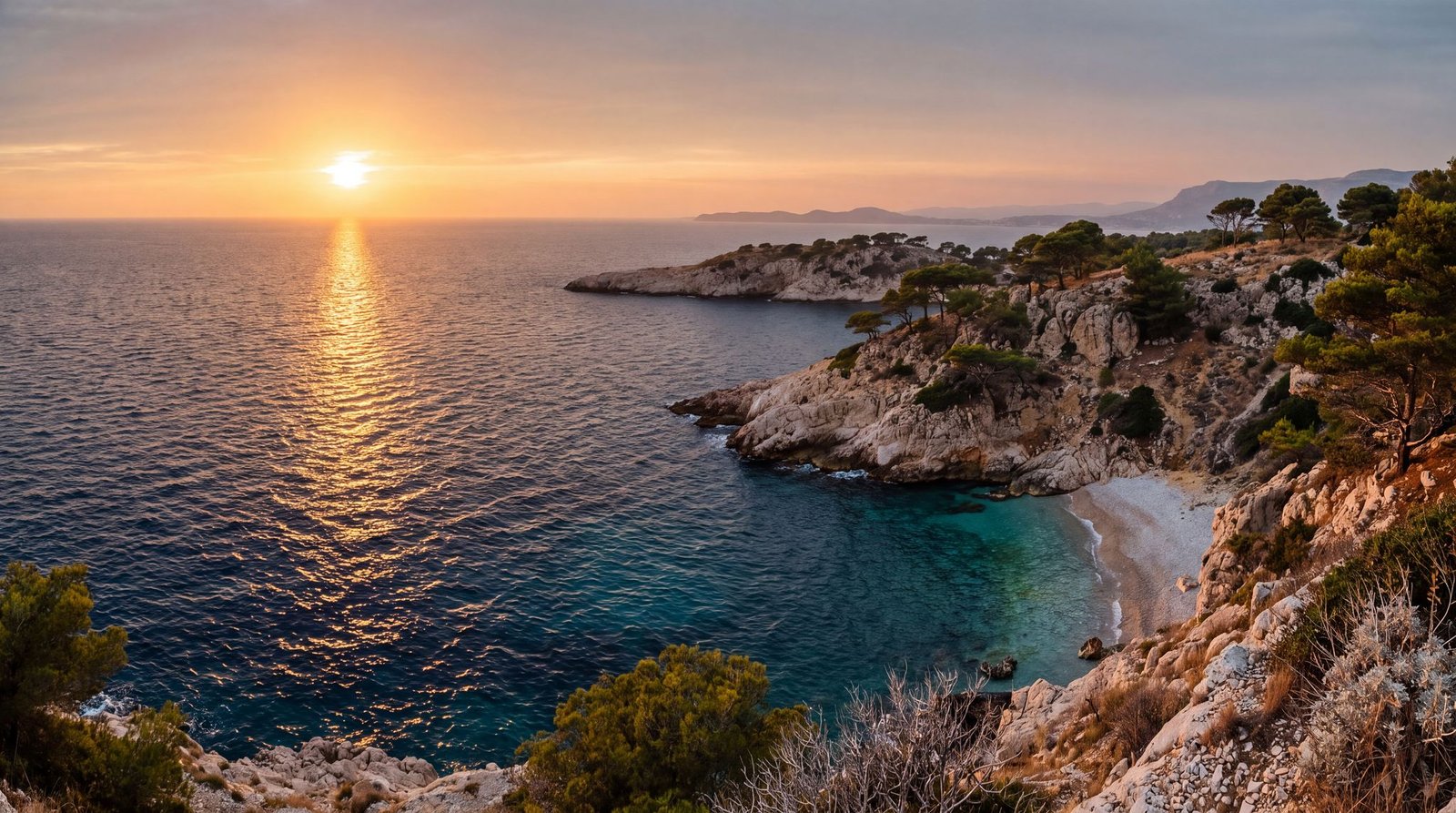
Fourth, the light. Photographers who have shot the Mediterranean across multiple seasons describe October light as categorically different from summer: lower angle, warmer tone, longer golden hour, no midday harshness. This is the light that makes the Amalfi coastline look the way it does in magazine photographs — the photographs that, ironically, were often taken in autumn by professionals who know not to visit in August.
Italy in October
The Amalfi Coast in October is what summer visitors are trying to experience but can't access through the volume. Ravello has rooms. The boat rentals have availability. Dinner at the cliff-edge restaurants on any night you choose, not just the one slot they had left at 6pm or 10pm. The coastal road is driveable. The water is still warm enough to swim from the private lido at your hotel. This is the version that justifies what the Amalfi Coast charges.
Tuscany in October is the truffle and harvest version that every food and travel publication writes about but almost no leisure traveler actually books into. White truffle season in San Miniato begins in October. The Chianti harvest is underway or just completing. Many of the private estate wineries — the ones that don't take walk-in tours in summer because they're too busy — open to properly arranged visits. The landscape has turned gold and amber. The agriturismo accommodations that were booked solid in summer have space.
Rome in October runs at a manageable volume — still busy, but not the anthropological event it becomes in July. The queues at major sites are shorter, outdoor dining is comfortable at all hours, and the city is doing its own thing rather than performing for the high-season peak. October is consistently among the best months on record for Rome weather.
Puglia — the heel of the Italian boot — has its olive harvest running through late October, which is both visually striking in the groves and practically meaningful if you're staying at any of the masserias (farmhouse estates) in the region. The Adriatic coast is quiet. The trulli in Alberobello are photographable without crowds. The food is at its seasonal peak.
Greece in October
The Greek islands operate mostly through the end of October, with the popular Cyclades islands (Santorini, Mykonos, Naxos, Paros) remaining fully open through the month. The smaller islands and some Dodecanese properties begin closing in late October, but the main circuit remains accessible.
Santorini in October has the same caldera, the same sunsets, the same architecture — and a fraction of the August visitor count. The sunset viewpoint in Oia, which in summer requires arriving ninety minutes early to stake a position, is navigable. The cave hotels have availability. The sea, accessed from the island's volcanic beaches, remains swimmable through mid-October.
Mykonos, which operates primarily as a nightlife and beach destination at peak season, has a different character in October: the beach clubs are winding down, the superclubs are quiet, and what remains is an extraordinarily handsome Cycladic village that is finally legible as a place rather than an event. If the beach-club Mykonos isn't what you were seeking, October is when you find the other version.
Athens in October is one of the most pleasant versions of the city. The heat has broken, the Acropolis is manageable in the morning hours, and the restaurants and neighborhoods in Monastiraki and Psiri that are gridlocked in summer have space and pace.
Croatia and Turkey
Dubrovnik in summer is a genuine overcrowding problem — cruise ships dock daily and disgorge passenger loads that turn the Old City's limestone streets into a single-file shuffle. October resolves this almost entirely. The walls are walkable. The restaurants in the Old City have tables. The water is still warm enough to swim from the rocky beaches below the city walls.
The Dalmatian Coast in October — Split, Hvar, Korčula — is operating but winding down; Hvar in particular is less reliably open in late October than it is in September. October is better suited to the Split and Dubrovnik end of the coast than the island circuit.
Turkey's Turquoise Coast — the stretch from Bodrum to Antalya via Fethiye and Göcek — has its final warm window in October. Sea temperatures remain at or above 22°C through the month, the gulets (traditional wooden sailing boats) are still operating with fewer charter clients than summer, and the coastal towns and ruins along the route have dropped back to manageable volume. This is the last good month for a gulet charter before the winter weather closes the route.
Morocco
Morocco operates on a different seasonal logic from coastal Mediterranean destinations. Marrakech in July and August is genuinely hot — regularly above 40°C in the medina — and October is when the Sahara and High Atlas become the primary draw. October opens the Atlas trekking season: daytime temperatures in the mountains are cool and clear, the high passes are accessible before the first winter snow, and the trails are not yet carrying the spring trekking crowds.
The Sahara in October is warm during the day (28–32°C) and cold at night — which is the version the desert camps are built for. The temperature swing is the experience; the summer heat, which pushes daytime temperatures to 45°C or above, removes the overnight element that makes a Sahara camp stay what it is. October is one of the two best months for Merzouga and the Erg Chebbi dunes (the other is April).
Marrakech itself is comfortable for medina walking, rooftop dining, and day excursions to the Atlas villages in October. The city is not a seasonal destination in the way that coastal Europe is, but October is categorically better than summer.
The one caveat worth knowing
October comes with a practical reality: the tourist infrastructure is actively winding down, not at full capacity. Ferry schedules in Greece thin out significantly in October, making island-to-island routes less frequent and some smaller islands difficult to reach. Certain properties — particularly smaller boutique hotels and camps on the Greek islands — close in late October or even mid-month. A few restaurants in smaller Amalfi and Positano villages are closed on weekdays by October.
This is not a reason to avoid October. It is a reason to verify what's open before booking, particularly for the second half of the month. An itinerary built around verified-open properties and a manageable island circuit is a better October trip than one that assumes summer-level availability. The planning step is simply part of the deal.
What you get in exchange is the Mediterranean at its most rewarding: warm, accessible, beautiful, and emptied of the summer volume that compresses everything into queues and advance bookings and availability anxiety. October is not a compromise. In most years, it's the best version of the trip.
How we build October itineraries
When a client asks about the Mediterranean, the first question we ask is whether the dates are fixed. If there's flexibility, October is almost always our recommendation over August or September — and the explanation takes about two minutes before they agree. We verify property availability, confirm ferry and access routes, and build around what's actually open. The trip you get is materially better than the summer version at the same or lower cost.