The most common mistake in safari planning is treating Africa as a single destination with a single season. It is not. East Africa, southern Africa, and South Africa each operate on different seasonal logics. The Great Migration in the Masai Mara peaks in August. The Okavango Delta's water levels are highest in June and July — fed by Angolan rains that fell four months earlier and drained 1,000 kilometers south. The South Luangwa in Zambia is best in October, at the end of the dry season, when the Luangwa River has shrunk to a narrow channel and every animal on the valley floor is competing for what's left of it. These are not interchangeable.
This calendar covers the major regions and the specific windows that produce the best experiences within each one. It also makes the case for the green season — November through April in most of southern Africa — which is where some of the most spectacular and least-appreciated safari experiences happen.
The two fundamental season types
African safari timing is built around two logics that apply differently by region. The first is the dry season advantage: as water sources dry up, animals concentrate at the remaining rivers, waterholes, and pans — which means more sightings per drive, more density at each sighting, and better visibility through thinning vegetation. The classic dry season experience is southern Africa May through October: herds of elephant at a single waterhole, predators patrolling predictable routes, the landscape stripped back to bare ground and low-growing shrubs.
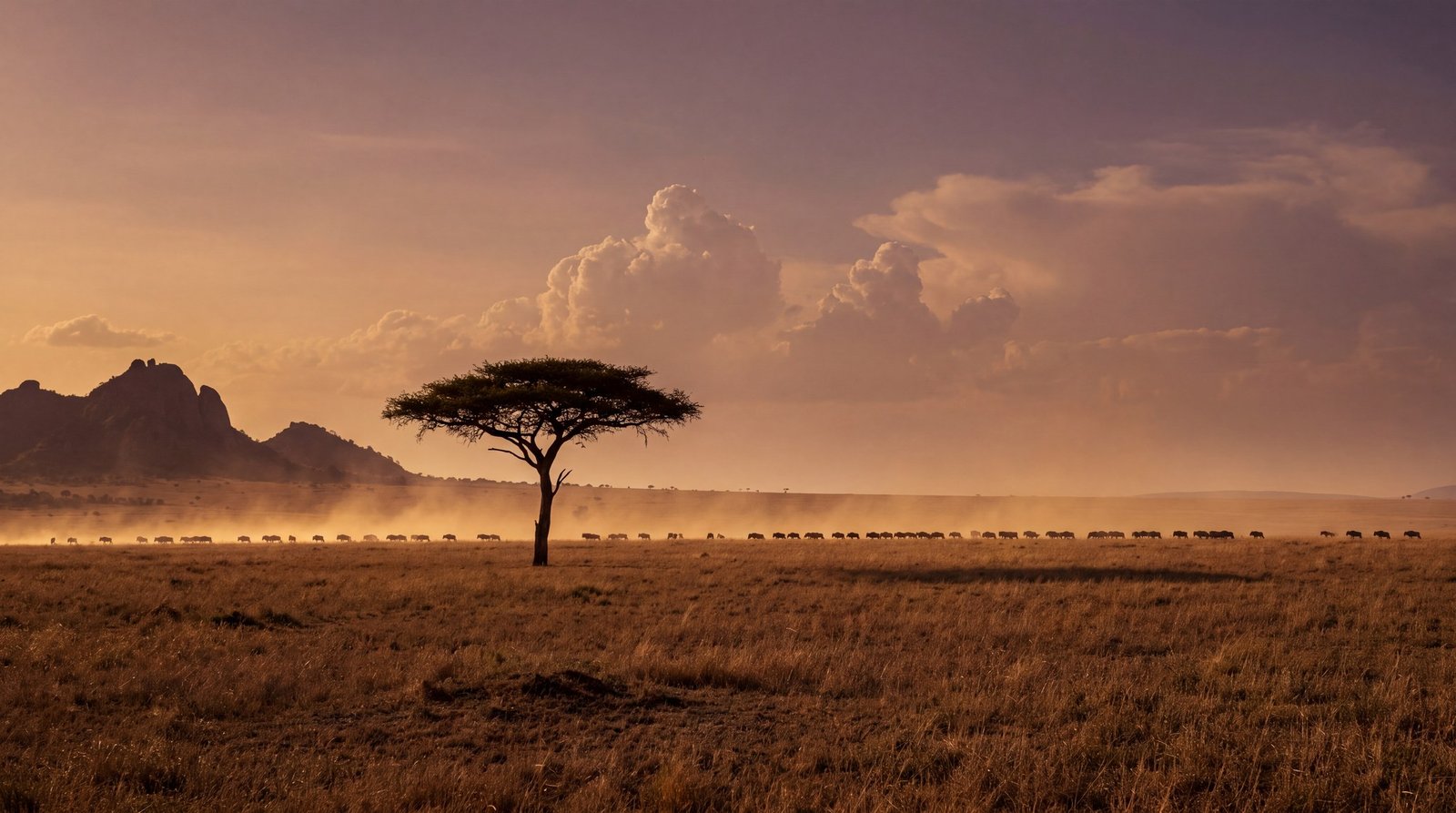
The second logic is the migration: the largest mammal migration on earth, in which approximately 1.5 million wildebeest, 200,000 zebra, and 400,000 Thomson's gazelle move in a continuous circuit around the Serengeti-Mara ecosystem in northern Tanzania and southern Kenya. The migration is year-round — it never stops — but it occupies different parts of the ecosystem in different months, and the specific event most travelers associate with the migration (the Mara River crossings, in which thousands of wildebeest throw themselves into a crocodile-patrolled river) happens in one specific place during one specific window.
East Africa: The Serengeti-Mara circuit
The Great Migration month by month
January – February: The calving season in the Ndutu region of the southern Serengeti. 400,000 wildebeest calves are born in a six-week window — one of the most dramatic wildlife spectacles in Africa, and the event that draws the most predator density anywhere in the ecosystem. Cheetah, lion, leopard, hyena, and wild dog all converge on the Ndutu plains. The timing is compressed and remarkable, and the Ndutu camps (Ndutu Safari Lodge, &Beyond Ndutu, Sanctuary Ndutu) are positioned directly in the calving grounds. This is the most underrated window in the entire migration calendar.
March – May: The herds move northwest through the central and western Serengeti, following the seasonal rains. Game viewing is good but dispersed. April is the long rains; some camps close. May marks the beginning of the dry season and one of the better value windows — green season rates, increasing visibility, good predator activity.
June – July: The northern Serengeti and the Kenya border. The herds are massing near the Mara River for the first crossings. June is increasingly popular as a "quiet Mara" month — the wildebeest are arriving but the July–August crowds haven't peaked. The best time to be in the Mara if you want the crossings without sharing them with dozens of vehicles.
August – October: Peak season in the Masai Mara. The river crossings happen most frequently in August and September — enormous, chaotic, terrifying, exactly what the photographs show. The Mara is also at maximum vehicle density: the river crossing sites can have 20 to 40 vehicles waiting for a crossing at peak times. The experience is still extraordinary; it is not a quiet one. By October, the herds begin moving south again. The Mara empties, the Serengeti corridor north of the park fills up.
November – December: The short rains. The herds are in the eastern Serengeti moving toward the southern calving grounds. November is the green season transition — dramatically beautiful, fewer tourists, lower rates, and excellent game viewing in the areas through which the migration is passing.
Jan
Feb
Mar
Apr
May
Jun
Jul
Aug
Sep
Oct
Nov
Dec
Masai Mara / Serengeti — Wildebeest Migration
Calving
Calving
Moving NW
Long Rains
N. Serengeti
Crossings
Crossings
Crossings
S. Move
S. Move
Short Rains
S. Serengeti
Southern Africa: Botswana, Zimbabwe, Zambia
Southern Africa's safari regions share a dry season logic that runs May through October, with the best game viewing intensifying as the dry season progresses and water sources become more concentrated.
Botswana's Okavango Delta operates on its own flooding cycle. The delta fills from May through August — fed by Angola's March rains draining south through the Kavango River — reaching maximum flood in June and July. This is when the mokoro (dugout canoe) season is at its finest: the papyrus channels are navigable, the islands are game-rich refuges surrounded by flood water, and the delta's extraordinary birdlife is at peak density. By September and October, the waters recede, the vegetation thins, and the land-based game viewing increases. The Moremi Game Reserve, which sits in the heart of the delta, has excellent wildlife year-round but different character in different months — water-focused and intimate in June/July, open and concentrated in September/October.
South Luangwa, Zambia is best in the late dry season: September and October, when the Luangwa River is at its lowest and thousands of animals are compressed onto the remaining floodplain. The walking safari tradition here — the South Luangwa is where walking safaris originated, with Norman Carr in the 1950s — is at its finest in these months because the vegetation is low enough to see clearly and the animal density is high enough to make every walk productive.
Hwange National Park, Zimbabwe peaks in September and October for the same late dry season logic — the 60+ pumped waterholes that were developed to supplement the natural water sources become the organizing geography of the park as natural water disappears. The elephant herds that converge on Hwange in October are among the largest concentrations anywhere in Africa.
Jan
Feb
Mar
Apr
May
Jun
Jul
Aug
Sep
Oct
Nov
Dec
Okavango Delta (Botswana)
Wet
Wet
Transition
Dry Begins
Flood Arrives
Peak Flood
Peak Flood
Dry Game
Dry Game
Late Dry
Short Rains
Wet
South Luangwa (Zambia)
Closed
Closed
Closed
Opens
Early Dry
Good
Excellent
Excellent
Peak
Peak
Closes
Closed
South Africa: Kruger and the Cape
South Africa operates on two overlapping seasonal products that serve different travel styles. The Kruger National Park and the private reserves bordering it (Sabi Sand, Timbavati, Klaserie) follow the dry season safari logic — best May through September, when the vegetation thins, water concentrates at rivers and waterholes, and lion and leopard sightings improve dramatically as ambush cover reduces. Leopard sightings in the Sabi Sand are among the most reliable in Africa, year-round, but peak in the dry months when the grass is low.
The Western Cape and Garden Route — wine regions, coastal hiking, the Whale Coast — operate on a reversed calendar. The best time is October through April (austral spring and summer): the fynbos is in bloom, the wine harvest runs February through April, and the Southern Right Whales are visible from Hermanus August through November as they come to Walker Bay to calve. A combined Cape Winelands and Kruger safari is possible year-round but works best in the overlapping shoulder: September and October, when Kruger is excellent and the Cape is emerging into spring.
The green season case
The green season — November through April across most of southern Africa — is the most underused window in safari travel. Rates at most camps are 20 to 40 percent lower. The landscape is extraordinary: the bush is lush, the skies are dramatic with afternoon thunderstorms, and the light for photography is different from the flat, dusty quality of the late dry season.
What the green season delivers that dry season cannot: the calving season spectacle in Ndutu (January–February), the highest cheetah and wild dog activity as denning begins, the most productive birding of the year (migratory species are present, and the summer residents are in breeding plumage), and the genuine solitude of camps running at 30 to 40 percent occupancy. The animals don't leave Africa in November. They disperse across a more abundant landscape, which means individual sightings are less frequent per drive but the encounters — when they happen — are often more intimate than the vehicle-dense dry season version.
The valid reason to avoid the green season in some areas: genuine access problems. Some camps in the Okavango Delta and parts of the Serengeti close during the rains because roads become impassable or flooding affects operations. The camps worth considering in the green season are those that specifically design their programming around it — not those that stay open by default and deliver a reduced experience.
Building the right itinerary
The timing conversation is the first one we have when a client is planning a safari, because the month determines everything else — which ecosystem, which camp category, which specific wildlife event to build around. If you have dates flexibility, we can usually find a window that delivers more of what you're after than the default peak season booking. Tell us the experience you want; we'll work backwards to the best window for it.