
Planning Advice 10 min read

Safari Planning: The 12 Questions Worth Asking Before You Book

Most people ask about price and availability. The questions that actually determine the quality of the experience rarely come up — until it's too late to change anything.

I've been planning safaris for twenty years. In that time I've watched a lot of well-intentioned trips go sideways — not because the destination was wrong or the season was poor, but because the client didn't know which questions to ask, and nobody thought to ask them on their behalf. A great-sounding camp with an unlimited-vehicle sighting policy is a fundamentally different experience than an identical-looking camp with a two-vehicle limit. Most people only find that out when they arrive.

These are the twelve questions I ask on every safari booking, in roughly the order they matter. Some of them are uncomfortable to ask directly. Ask anyway. A camp or operator that bristles at these questions is telling you something important.
01

How many vehicles does the camp allow at a single sighting?

This is the most important question on the list, and the one almost nobody asks. The difference between a two-vehicle limit and an unlimited-vehicle policy is the difference between a private moment with a leopard and a parking lot. Both experiences involve a leopard. Only one of them is what you came for.

In the high-end Botswana camps, strict sighting limits — typically two to four vehicles — are standard practice and often written into the concession agreement. In the more accessible reserves of Kenya and Tanzania, particularly the Masai Mara during peak season, vehicle limits are harder to enforce and frequently ignored. Know which situation you're walking into.

Good answer "We have a strict two-vehicle limit at all sightings, and our guides are instructed to leave if that limit is exceeded by other operators."
Watch out for Any answer that deflects to "it depends on the reserve rules" without telling you what the camp's own policy is. The camp's culture matters as much as the regulations.
02

How long has your head guide been at this specific property?

There is a profound difference between a guide who has spent fifteen years in one ecosystem and a guide who rotated in six months ago from a different reserve. The long-tenure guide knows the individual animals — their territories, their habits, which female cheetah hunts at which hour on which stretch of road. That knowledge is not teachable in training. It accumulates over years, and it determines the quality of every game drive you take.

Many camps have excellent reputations built on the strength of one or two exceptional guides. Those guides are worth asking about by name. If the camp can't tell you who will be guiding your specific stay, or if there's high turnover in the guiding team, treat that as a yellow flag.

Good answer A specific name, a specific number of years — "James has been our head guide here for eleven years" — and ideally some detail about what makes that guide exceptional.
Watch out for Vague references to "our highly trained team" without specifics. Staff turnover at a camp is rarely advertised. Ask directly: "What is the average tenure of your current guiding staff?"
03

Is the camp inside or outside the reserve boundary — and what does that mean for access?

Camp placement relative to the reserve boundary has consequences that aren't obvious from a map. Camps located inside a national park or game reserve are typically bound by park rules: no off-road driving, no night drives, vehicles must be out of the park by a certain hour. Camps on private conservancies adjacent to the reserve — or on private land with a concession agreement — often operate under different rules entirely.

Off-road vehicle access means the guide can follow an animal into the bush rather than watching it disappear from the road. Night drives mean you can encounter leopards, lions, aardvarks, and dozens of nocturnal species that are completely invisible during daylight hours. These are not minor perks. They define a different category of safari experience.

Good answer "We operate on a private concession with full off-road access and night drive permits. Our drives are not constrained by park closing times."
Watch out for The phrase "we are located adjacent to the reserve" as a way of implying access that doesn't actually exist. Ask specifically: "Can your vehicles leave the road? Do you do night drives? Do park opening hours apply to your guests?"
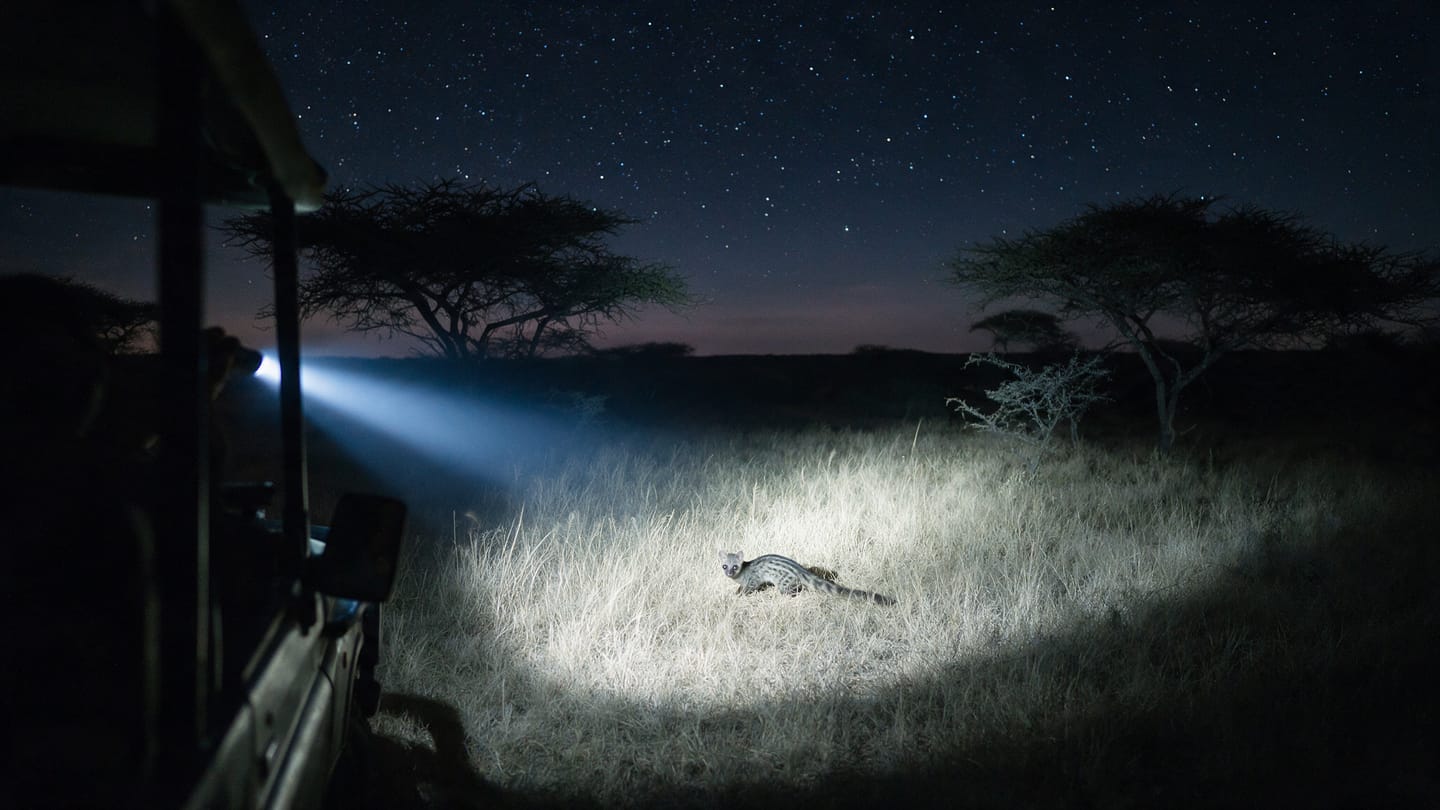
A spotlight beam sweeping tall grass from an open vehicle on an East African night drive

Night drive access is determined by concession agreements, not camp quality. It's one of several distinctions that don't appear in any booking description.

04

Will we have a private guide, or share one with other guests?

The answer to this question determines almost everything about the texture of your game drives. A private guide means the vehicle goes where you want to go, stays as long as you want to stay, and operates on your schedule. A shared guide means compromises — the other couple wants to leave the lion sighting early because they're cold, or they'd rather skip the birds and get back for lunch.

At most quality camps, private guiding is either standard or available at a supplement. At some camps — particularly those operating on tighter margins — shared vehicles are the default. Neither is inherently wrong, but you should know which situation you're in before you arrive, not after.

Good answer A clear statement of the policy: private vehicle included, shared vehicle standard with private available, or maximum passengers per vehicle specified.
Watch out for "We'll do our best to accommodate your preferences" — this is not an answer. It means shared is standard and private is uncertain.
05

What is included in the daily rate — and what isn't?

Safari camp pricing is genuinely confusing, and the confusion is not always accidental. A "fully inclusive" rate at one camp might include all meals, all activities, all drinks, laundry, and transfers. The same phrase at another camp might exclude premium spirits, certain activities, conservancy fees, and the light aircraft transfers that are effectively mandatory to reach the property. Two camps with similar daily rates can have final invoices that differ by hundreds of dollars per person per night.

The items most commonly excluded from headline rates: conservancy or park fees (which can add $80–150 per person per night in some reserves), premium beverages, laundry, gratuities, and inter-camp transfers. Ask for a written breakdown of what a seven-night stay actually costs, all in, before you compare camps against each other.

Good answer An itemized breakdown: meals, house wines and spirits, activities, conservancy fees, laundry, Wi-Fi, and transfer costs all stated clearly — included or excluded.
Watch out for Any version of "most things are included." That phrase exists specifically to avoid answering the question.

"Two camps with similar daily rates can have final invoices that differ by hundreds of dollars per person per night. The headline rate is a starting point, not a price."

06

How many guests does the camp hold at full capacity?

Camp size sets a ceiling on intimacy that no amount of quality service can override. A camp with twenty-four beds, fully occupied, is a fundamentally different social experience than a camp with eight beds. Both might have excellent food, excellent guiding, and excellent accommodation. But one of them has you sharing a communal dinner with eleven strangers every night and competing for the prime vehicle positions on every drive.

In practice, the camps I book again and again — and that I recommend most consistently — cap out at twelve guests or fewer. At six to eight guests, the experience begins to feel genuinely private. The guides know your preferences by the second drive. Meals become conversations rather than restaurant-style service. The pace of the whole experience changes.

Good answer A specific bed count: "We have six tented suites, so we never exceed twelve guests." Follow up with typical occupancy in your travel window.
Watch out for Camps that list "intimate" in their marketing copy but hold eighteen or more beds. Intimate is a feeling that requires a specific size to produce — it is not a design choice.
07

What aircraft will be used for internal transfers, and what are the luggage rules?

The light aircraft transfers that connect safari camps in Botswana, Tanzania, and Kenya are a significant part of the experience — the low-altitude approach over the Okavango Delta at dawn, the landing strip that is literally a dirt track in the bush. They are also the part of the logistics that surprises people most when they haven't prepared.

Light aircraft in safari contexts typically means a six- to nine-seat Cessna Caravan or similar, with a strict luggage allowance of 15kg (roughly 33 lbs) in a soft-sided bag. Hard-shell suitcases often cannot be carried. The weight limit applies to everything — camera gear, clothing, toiletries. This needs to be planned for well in advance of departure, not discovered at the Maun or Arusha airport.

Good answer Aircraft type specified, luggage weight limit and soft-bag requirement stated clearly, and whether charter transfers are included in the rate or invoiced separately.
Watch out for Luggage allowances buried in the fine print of booking terms. If a client finds out at the airport, that's a planning failure.
08

What is your guide's formal training and certification?

In southern Africa, the Field Guides Association of Southern Africa (FGASA) operates a tiered certification system — Level 1, Level 2, and the Apprentice Trails Guide qualification for walking safaris. These certifications require documented training, field assessments, and first aid qualifications. They are not a guarantee of an exceptional guide, but they are a meaningful baseline that distinguishes someone who has been through rigorous assessment from someone who grew up in the area and picked up the work informally.

For walking safaris in particular — in South Africa, Zimbabwe, and Zambia — guide certification carries real safety implications. A walking guide carrying a rifle in leopard and lion country should have demonstrable training in firearm use and emergency protocols. Ask directly. A well-run camp will answer without hesitation.

Good answer FGASA Level 2 or equivalent for driving guides; Trails Guide qualification or equivalent for walking safari leads. Specific certifications named, not paraphrased.
Watch out for "Our guides are highly experienced" without credentials. Experience is a starting point. Training is a verifiable standard.
On Walking Safaris

Walking safaris deserve their own pre-booking conversation. The experience of moving through the bush at ground level — wind direction, track identification, insect behavior — is categorically different from a vehicle-based drive, and the guide's knowledge at that level determines everything. If a walking safari is part of your itinerary, ask specifically about the walking guide's experience, the firearms carried, the protocols for dangerous animal encounters, and the maximum group size. These questions are not alarmist. A good walking guide will be glad you asked them.

09

What is your medical emergency protocol?

This question feels morbid to ask on a vacation inquiry. Ask it anyway. The distance between a remote safari camp and the nearest hospital capable of handling a serious medical event can be measured in hours of flight time. Knowing that gap exists, and understanding exactly how it gets bridged, is not pessimism — it is basic due diligence for any trip this far off the grid.

Most reputable safari camps have an established relationship with a medevac operator — AMREF in East Africa, and Helicopter Medical Rescue or similar services in southern Africa. They maintain first aid-trained staff, satellite communication, and a documented emergency plan. They will answer this question in detail and without discomfort, because it's part of their operating reality.

Good answer Named medevac partner, communication system specified (satellite phone, VHF radio), first aid qualification of camp staff, and nearest trauma hospital identified.
Watch out for Vague reassurances. "We'll take care of you" is not a medical emergency protocol.
10

How does the camp handle the wet season, and does it close?

Many of the best safari camps close entirely during the heart of the wet season — typically December through March in southern Africa — for maintenance, renovation, and staff leave. A camp that reopens in April or May after three months of downtime is often at its physical best: fresh linens, repaired infrastructure, fully rested and motivated staff. This matters more than it might seem.

Camps that remain open year-round in wet season regions may do so because they have strong wet-season game (Botswana's flood season, for instance, is a real attraction in itself), or they may do so simply because closing is not financially viable. The former is fine. The latter can produce a camp that is showing its age and operating with reduced staff. Know which situation applies before you book the shoulder months.

Good answer Clear dates for any closure, explanation of what the wet season experience actually looks like if they stay open, and honest assessment of what changes during that period.
Watch out for Camps that describe wet season as "green season" without acknowledging what actually changes — road access, fly-camping availability, certain activity types.
11

What is the camp's conservation and community relationship?

This is not a box-ticking question about corporate responsibility. It's a practical question about long-term viability. Camps with genuine, structured relationships with the surrounding communities — revenue sharing, local employment at senior levels, community-owned land agreements — operate in a fundamentally more stable environment than camps that treat conservation as marketing language.

A camp on community-owned land where locals have a direct financial stake in its operation is one where the wildlife is actively protected, the anti-poaching effort is community-driven rather than externally imposed, and the guides are more likely to be local people who have lived alongside the animals their entire lives. That's not an ideological position. It produces better safaris.

Good answer Specific partnership named, percentage of revenue that goes to community trust, local employment percentage at guiding and management level, and named conservation projects supported.
Watch out for Photographs of children in camp brochures without any description of the actual financial or operational relationship with surrounding communities.
12

What should I actually pack — and what do I not need to bring?

This is the question most camps will volunteer an answer to, and it's still worth asking explicitly because the answer changes depending on the specific reserve, season, and planned activities. A guest heading to the Okavango Delta in June needs different layers than someone doing a Tanzania migration camp in August. A walking safari requires different footwear than a vehicle-based trip. A camp with a swimming pool and relaxed afternoon schedule changes the clothing calculus entirely.

The most common packing mistakes I see: bringing hard-shell luggage on a light aircraft transfer, packing more clothing than the luggage limit allows, bringing camera gear that exceeds the weight allowance, and — this one surprises people — bringing too many neutral colors when the camp operates vehicles with open sides and the dust and sun require more sun-protective layers than most people expect.

Good answer A specific packing list, weight limit reminder, soft-bag requirement stated, and clear guidance on what the camp provides (binoculars, rain ponchos, laundry service) versus what to bring.
Watch out for A generic packing list that could apply to any safari in any season. If the guidance doesn't mention your specific camp or season, it wasn't written for your trip.

What to do with the answers

The purpose of these questions isn't to catch a camp out. Most good camps will answer all twelve without hesitation, because they've thought carefully about all twelve and the answers reflect genuine strengths. The value is in creating a basis for comparison — and in surfacing the camps that can't answer clearly, which tells you something important before any money changes hands.

If a camp gives you vague or evasive answers to more than two or three of these questions, that's useful information. It doesn't necessarily mean the camp is bad. It may mean the person you're speaking to doesn't know the answers, which is its own problem. A well-run camp makes this information available, in writing, without being asked twice.

The best safari I ever planned for a client involved a camp that sent a twelve-page document answering every one of these questions before we'd finished the first phone call. They'd written it themselves, unprompted, because they knew what mattered and were proud of what they'd built. That document told me more about the quality of the operation than any review site ever could.

That's the camp you're looking for.

Asking These of a Real Itinerary

The twelve questions land differently by country. Botswana answers most of them through concession type; Kenya and Tanzania answer them through where a camp sits against the migration.

The safari and wildlife travel page is where those answers get turned into an actual camp list.


About the Author

Mark Sole

Founder & Travel Director

Mark has planned safaris across Botswana, Kenya, Tanzania, Zimbabwe, Zambia, and South Africa for twenty years. He has stayed at more than sixty African safari camps, knows which questions separate the exceptional operations from the merely good ones, and has strong opinions about vehicle sighting limits.

Learn more about Mark
Plan Your Safari

Ready to start asking the right questions?

I ask all twelve of these on every safari inquiry I handle — and a few others that didn't make the list. If you're planning a first safari or looking to do Africa properly after a trip that didn't quite land, let's talk through what actually matters for your specific situation.

Plan My Trip  →
Botswana, Kenya, Tanzania, Zimbabwe, Zambia, South Africa
May – October (varies by country)
7–14 nights
Complimentary planning consultation