Augusta National Golf Club does not sell tickets. It issues patron badges — a distinction that is not merely semantic. The language signals the relationship the club intends: you are a guest of the institution, operating under its rules, within an environment it has constructed with absolute deliberateness. There are no visible corporate sponsors anywhere on the 365 acres. The concession prices are controlled at 1990s levels. Phones may not be used on the course. The crowds — patrons — are expected to behave accordingly, and largely do.
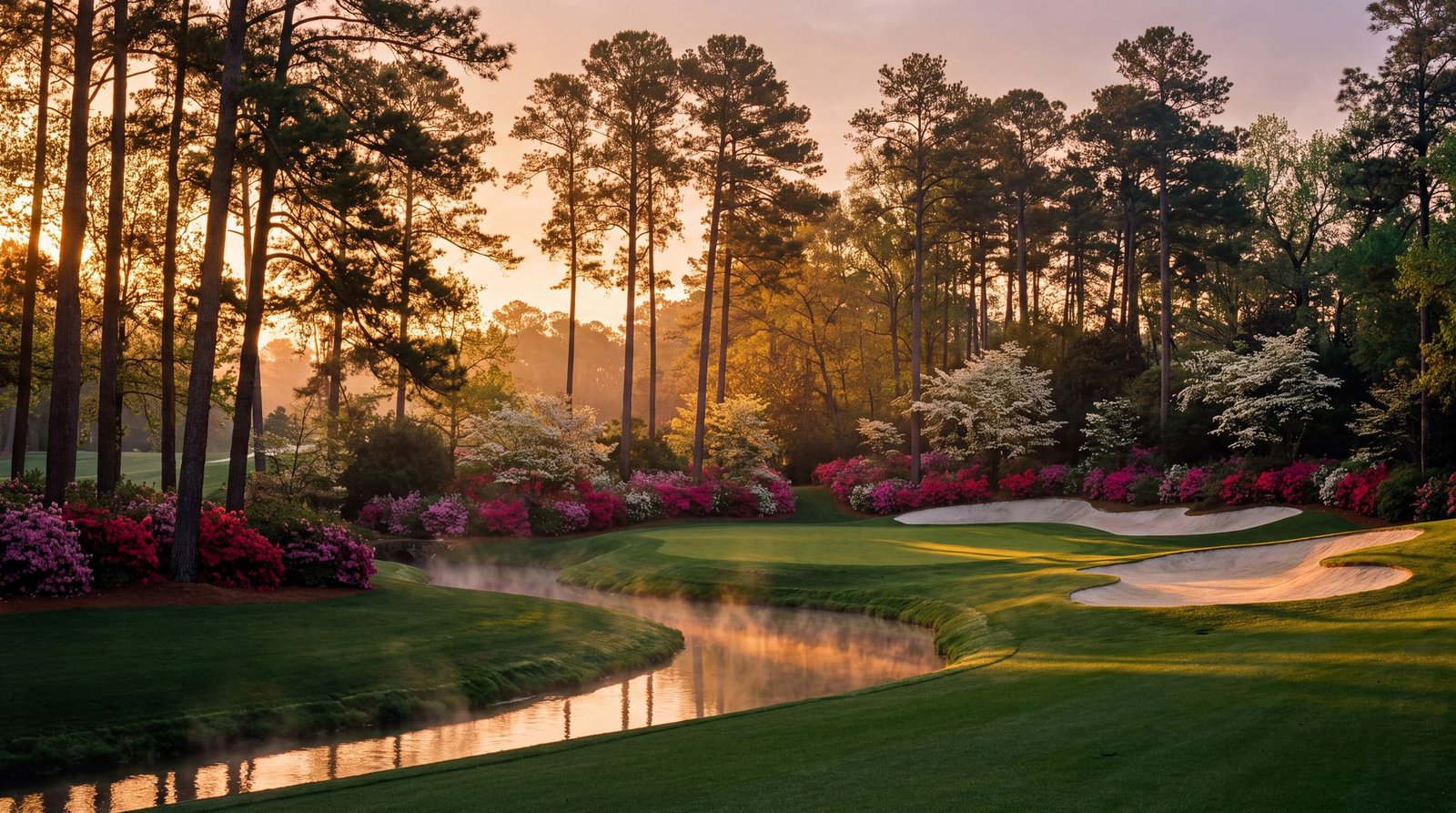
The result is an event that feels unlike any other major sporting occasion in the world. The Masters is quieter than it should be for 40,000 people. The course is more beautiful in person than it appears on television, which is saying something given that Augusta National's television production is the most carefully considered in golf. The azaleas bloom in April at a density and color that the cameras reproduce faithfully and that still somehow manages to surprise you when you're standing at the top of the 13th fairway looking down at Rae's Creek.
Getting there is the hard part. Understanding what you're getting into once you do is the part this piece is for.
The badge question — how access actually works
The official waiting list for Masters tournament-round patron badges was closed in 1978 and has not reopened. The badges that exist — a finite number held by individuals and families who have maintained them for decades — transfer through inheritance, private sale, and institutional relationships. Augusta National does not facilitate this market. It simply exists around the club's immovable access structure.
Practice round badges (Monday through Wednesday of Masters week) are distributed by public lottery through Augusta National's official application process, which opens in June of the prior year. The lottery is heavily oversubscribed but not impossible — submitting an application every year is a reasonable strategy, and practice round access to Augusta National is a genuinely excellent experience, different from tournament rounds in specific ways that are worth understanding.
Tournament round badges (Thursday through Sunday) are not available through the lottery system. They move through three main channels: estate transfers among multi-generational badge-holding families; private brokerage through networks connected to Augusta National members and their corporate relationships; and the secondary market, where single-day badges for weekend rounds have regularly sold in the $3,000–$8,000 range depending on the year and the draw. A weekly badge — all four rounds — is a different category of asset.
The practical implication: if attending The Masters is on the list, the strategy involves either sustained lottery participation for practice rounds (the path most people take), or a relationship with someone positioned in the member-adjacent network (the path that produces tournament round access). We work with clients on both.
The course — what television doesn't show you
Augusta National was designed by Bobby Jones and Alister MacKenzie on the site of a former indigo plantation, and it opened in 1933. The course plays from the top of a hill — the clubhouse end — down through undulating terrain and back up across Rae's Creek, and the elevation changes are the first thing that surprises visitors who formed their mental model from television coverage. The broadcast cameras flatten the course. In person, the slope from the 10th tee to the green is steep enough that walking it at speed feels effortful, and the rise back up the 18th fairway toward the clubhouse is longer than it appears.
The course is also in condition that is difficult to fully describe. The grass is a specific texture of flawless — Bermuda fairways overseeded with ryegrass for the April tournament, the greens at a speed that makes professional golfers visibly cautious. The bunkers are raked to a standard that looks manufactured. The azalea plantings along the back nine — varieties selected for their April bloom timing — are at full color during Masters week, and the visual effect of the 13th hole (Azalea) in particular, with the creek bending in front of the green and the pink and white blooms banked against the trees, is the image that has represented The Masters for seventy years for a reason.
Walking the course means making a choice: follow a specific group for the full round, or position at a gallery spot and watch the field come through. Both are worthwhile strategies, but they produce different days. Following a marquee pairing at tournament pace means covering most of the 18 holes, moving with the crowd around the group, and experiencing the round as a narrative — stroke by stroke, conversation by conversation, the atmosphere building or deflating with the score. Positioning at Amen Corner (the stretch of holes 11, 12, and 13) means staying in one of the most strategically consequential locations in major championship golf and watching every group play through over the course of several hours. The par-3 12th — Golden Bell — is 155 yards over Rae's Creek, plays into a green that reads like a shelf, and has ended more Masters than any other hole. Watching it repeatedly over an afternoon is its own education in the event.
Amen Corner and the 16th — where the tournament is decided
The stretch from the 11th through the 13th — named Amen Corner by sports writer Herbert Warren Wind in 1958 — is where the back-nine pressure of a major championship becomes most visible. The 11th (White Dogwood) is a long par 4 with a pond guarding the left of the green that punishes any approach that misses right-to-left. The 12th is the shortest hole in Masters history and arguably the most feared. The 13th (Azalea) is a reachable par 5 with a creek that crosses directly in front of the green — the hole where aggressive second shots either produce eagles that change leaderboards or balls in the water that end contention.
The 16th (Redbud) is the other location worth knowing. It is a par 3 over water with a tiered green, and the amphitheater seating that Augusta National has built around it creates one of the most concentrated gallery experiences in golf. When a leader hits the 16th green on Sunday afternoon, 15,000 people are in proximity to what happens next, and the noise level in that moment is the loudest Augusta National gets — which is still, by comparison to most major sporting events, strikingly controlled.
Practice rounds and the Par 3 Contest
If tournament round access isn't available, practice rounds are not the consolation prize they might appear. On Monday through Wednesday of Masters week, the gates open and patrons can walk the course freely — following players at close range that the tournament's crowd management makes impossible on Thursday through Sunday. Players use practice rounds to test the greens, adjust to the speed, and work through their approaches to specific holes, and the access is genuinely intimate. A player and caddy walking up to the 13th tee with a single club and hitting six shots while studying the angles is a different level of golf observation than anything available during the tournament itself.
The Par 3 Contest on Wednesday afternoon is something else entirely. It is played on the separate nine-hole par 3 course behind the 10th tee, it carries no official consequence, and it has become one of the most genuinely affecting rituals in professional golf. Players' children and spouses caddy. The defending champion of the Par 3 Contest traditionally does not win The Masters the following day — a superstition with enough supporting data that several players have deliberately three-putted the 18th to protect themselves. The atmosphere is playful and unhurried in a way that disappears entirely when the tournament begins the following morning.
What Augusta National does that no other event does
Augusta National's control over the patron experience is total in ways that sound administrative until you are inside it. There is no visible commercial signage anywhere on the property — no branded banners, no LED sponsor boards, nothing. The corporate partnerships that fund the event are acknowledged once at the broadcast level and otherwise invisible on the grounds. The effect is an environment that feels, architecturally and atmospherically, like it belongs to no era in particular — as if the course and the tournament exist slightly outside the commercial framework that governs every other major event.
The concession pricing is one of the club's most discussed gestures: a pimento cheese sandwich — the Masters sandwich — costs $1.50. A Masters egg salad sandwich costs $1.50. Beer is under $5. The prices have been approximately this level for decades and are maintained deliberately. The club has the revenue and the margins to price differently. The pricing is a statement about what kind of place Augusta National intends to be.
The phone policy has evolved. Phones are now permitted in designated areas but may not be used on the course itself — no photography, no calls, no social media while walking the fairways. The enforcement is firm. The result is a crowd that is, in the main, actually watching golf rather than documenting themselves watching golf. In 2026, this feels unusual enough to notice.
The merchandise operation is a specific phenomenon. The Masters merchandise pavilion sells Augusta National branded goods that are not available anywhere else — the only authorized retail channel is on the grounds during Masters week — and the lines form early. Certain items sell out by Tuesday of practice round week. If merchandise is a priority, plan accordingly. If it isn't, the pavilion is still worth a walk through for the peculiarity of a sports brand that could license globally but chooses not to.
Augusta and the surrounding area
Augusta is a mid-sized Georgia city that is not, in any week other than Masters week, a major travel destination. During the tournament it becomes one of the more interesting hotel and hospitality markets in the country — not because the city's accommodation stock is exceptional, but because the demand concentration is extreme and the workarounds that develop around that demand are worth understanding.
The Partridge Inn on Walton Way is the historic property in Augusta — a 1930s grande dame that has been well-maintained, with a rooftop terrace and a history that connects directly to the Masters era. It books out entirely during tournament week, typically a year in advance. It is the right base if you can secure it.
Many serious Masters visitors stay not in Augusta but in Aiken, South Carolina, roughly an hour east — a historic equestrian town with genuinely good hotels and restaurants that operates at dramatically less congestion than Augusta during Masters week. The commute adds time but removes the parking and logistics friction of staying closer to the course.
Private home rentals in the Augusta area have become the preferred solution for groups — an entire house within driving distance of Augusta National, booked a year or more in advance. The economics for a group of six to ten people are often favorable compared to a comparable number of hotel rooms, and the social infrastructure of a shared house fits the rhythm of a Masters week better than a hotel corridor.
For dining, Frog Hollow Tavern is the most consistently cited fine dining option in Augusta — farm-to-table Southern cooking that is worth a reservation any night of the week. The city's dining landscape is improving, but Masters week dining reservations should be secured well before arrival.
Logistics worth knowing
Augusta National's parking situation is managed through a shuttle system — patrons park at designated remote lots and board buses that drop directly at the Washington Road gate. The club's parking management is efficient, but the volume on tournament days means arriving early is not optional if you want to be on the course when the first groups tee off. Traffic on Washington Road at peak arrival windows is significant.
Dress code is collared shirts for men; the club's expectation is neat, appropriate attire — nothing that would look out of place at a private golf club. The standard is politely enforced. Weather in April in Augusta is genuinely variable: the azaleas bloom at temperatures that can swing between 10°C and 28°C within the same week. The famously cold Masters Sunday has happened enough times that layers are the sensible approach for any round.
Bags allowed on the grounds are strictly limited in size — Augusta National's bag policy is specific and enforced. Periscopes, which were long a solution for viewing over crowds, are permitted but increasingly unnecessary given the general civility of the galleries. Folding chairs are permitted and widely used at gallery spots; arriving at a prime location early and staking a chair position before a round is standard practice for experienced Masters patrons.