
Destination Guide 15 min read

The Middle East Guide: Ancient History and the World's Newest Hospitality Infrastructure

The UAE, Jordan, Oman, Saudi Arabia, Egypt, and Turkey — six destinations that share a geography but almost nothing else, why the region is the most consistently underestimated in luxury travel, and the seasonal window that makes all of them work.

The Middle East is the most consistently underestimated luxury travel region in the world. The mental model most travelers carry — assembled from news cycles and geography lessons rather than first-hand experience — is typically a decade or more out of date. The reality on the ground in Dubai, Amman, Muscat, and AlUla is a hospitality infrastructure as sophisticated as anything in Western Europe or Japan, positioned against a landscape and historical depth that no other region on earth can match. Nowhere else presents the specific combination of 5,000-year-old carved cities, active desert civilizations, and the newest hotels ever built — often within a two-hour drive of each other.

The planning mistake is applying a political map to a travel decision. The six destinations in this guide — the UAE, Jordan, Oman, Saudi Arabia, Egypt, and Turkey — are not interchangeable and do not substitute for each other. They share a geography and, broadly, a climatic logic (the correct window is October through April for all of them), but their characters are as distinct as the difference between Italy and Sweden. The UAE is a city-state that willed itself into a global hospitality destination in the span of a single generation. Oman is the Gulf's most honest country — a place that chose cultural authenticity over spectacle and built a tourism product on that decision. Jordan contains two of the most extraordinary archaeological sites on the planet, in landscapes that were never intended as backdrops but have become them anyway. These are not similar decisions.

This guide covers the six Middle Eastern destinations that represent the best of what the region delivers at the luxury end of the market, the seasonal framework that applies across most of them, and the specific properties worth knowing before the planning conversation begins.

The Seasonality Question

The Middle East has the clearest seasonal logic of any region in this series: October through April is the window, and June through September is not. Summer temperatures across the Arabian Peninsula and Egypt regularly exceed 45°C and in some interior locations reach 50°C. This is not extreme weather that can be mitigated with air conditioning and timing — it is heat that changes the character of outdoor spaces entirely, closes desert excursion operators, and makes the archaeological sites that are the region's primary draws both uncomfortable and frequently overcrowded with visitors who have no better options. The shoulder months of March through May and September through October are the sweet spot: comfortable temperatures, lower hotel rates than the December–February peak, and the landscapes in their best condition.

Turkey is the partial exception. Istanbul's climate follows a European continental pattern rather than a desert one — the city is pleasant in May through October and has a distinct winter season that the Gulf countries don't. Cappadocia's balloon season runs April through November, with the best conditions in spring and autumn. The Turquoise Coast runs June through September, when the Aegean and Mediterranean sea temperatures justify the water. Planning a Middle East itinerary that combines Turkey with Jordan or Egypt can be structured around a shoulder season window that works for all three simultaneously.

"The Middle East is where the oldest human history and the newest hospitality infrastructure share a geography. No other region presents that combination — and none is more consistently underestimated by the traveler who hasn't been."

Six Regions at a Glance

Below is a breakdown of each region — its character, who it's right for, when to go, and the specific properties worth knowing. A timing guide and property reference section follow.

Region Overview · Middle East
The Numbers That Frame the Region
6
Distinct regions covered in this guide
Oct–Apr
The shared travel window across the region
12–16 hrs
Flight from US East Coast via connecting hub
Desert
Antiquities
City
Primary experience types this guide covers
Six Regions. Six Different Middle Easts.
01
The UAE — Dubai & Abu Dhabi
City-State Desert Hub & Base
Dubai · Abu Dhabi · Al Ain · Hatta · Empty Quarter
Dubai is the only city in the world built entirely as a destination — not one that accumulated tourism over centuries but one that made a deliberate decision in the 1990s to become a global hub and executed that decision at a scale and speed no comparable city has matched. The results are genuinely impressive at close range and easy to dismiss from a distance. The Burj Al Arab's sail silhouette above the Persian Gulf, the downtown skyline that has assembled more record-breaking buildings in a smaller area than any city on earth, the DIFC restaurant scene that has recruited chefs from Paris, London, and New York with the same unembarrassed ambition — this is a city that knows exactly what it's doing, invites you to have an opinion about it, and does not require your approval.

The desert outside Dubai is the corrective to everything the city represents. The Al Maha Desert Reserve, forty-five minutes from the city centre by road, is a protected conservation area of 27,000 acres where Arabian oryx have been reintroduced to habitat that once held them in the wild. The camp there is small, quiet, and dramatically removed from the Dubai that most visitors see. Abu Dhabi provides the cultural weight: the Sheikh Zayed Grand Mosque is the finest piece of contemporary Islamic architecture in the Gulf, the Louvre Abu Dhabi — designed by Jean Nouvel with a dome that creates a rain of light across the galleries — is a serious museum, and the Saadiyat Cultural District under development around it represents the most ambitious arts infrastructure project in the region.
Best Season: October – April (comfortable temperatures; outdoor activity viable) Avoid: June – September (45°C+; outdoor spaces largely unusable) Gateway: DXB (Dubai) or AUH (Abu Dhabi) — direct from JFK, IAD, LAX, ORD, IAH, BOS, MIA Key Properties: Al Maha Desert Resort (Dubai Conservation Reserve), Burj Al Arab (Dubai), Aman New York's sister property Aman Dubai (DIFC)
02
Jordan — Petra, Wadi Rum & the Dead Sea
Most Compelling Archaeology Desert
Petra · Wadi Rum · Dead Sea · Amman · Aqaba · Dana Biosphere
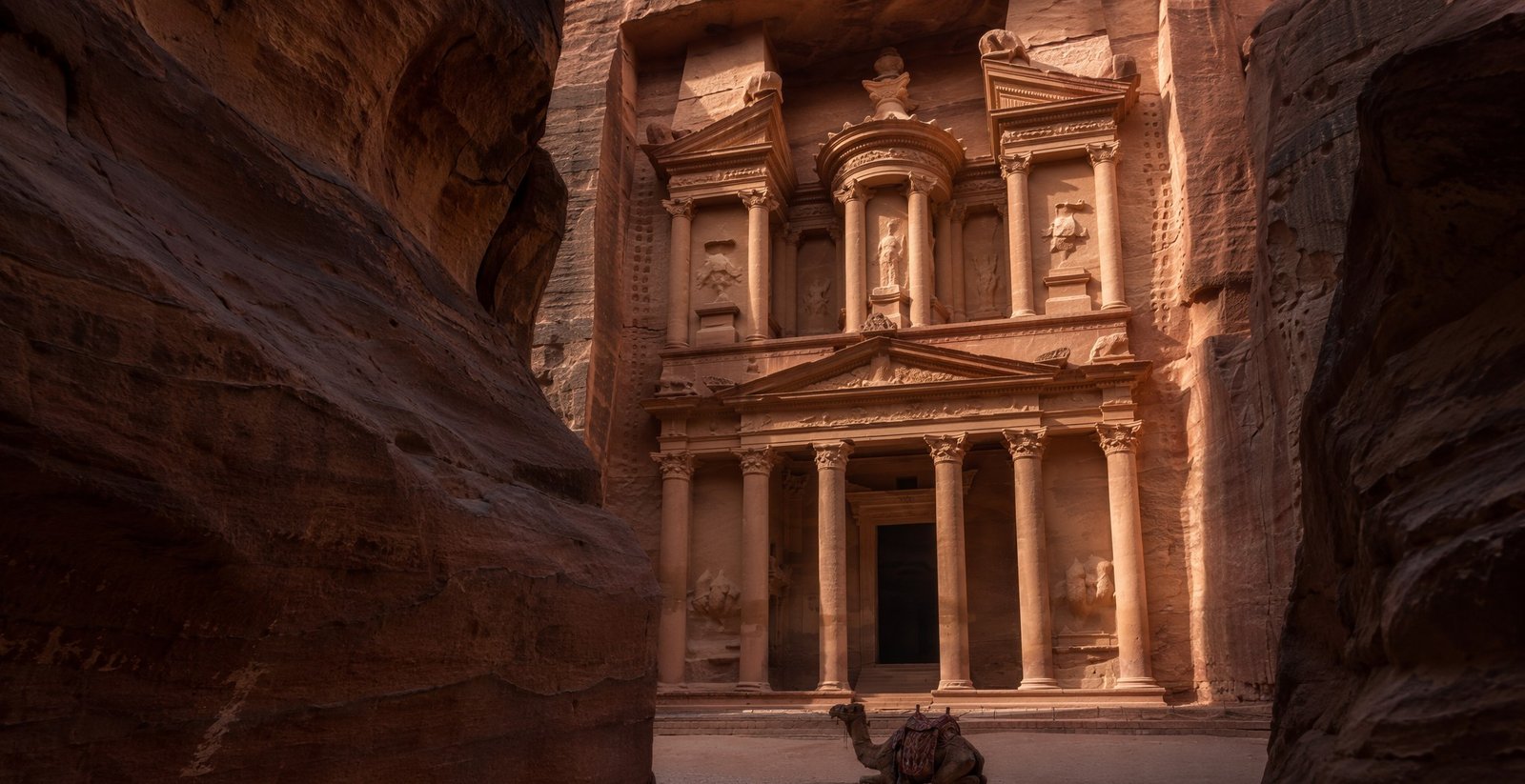
Jordan is the most compelling cultural and landscape destination in the Middle East, and among the most compelling in the world — a country that occupies a geographic position at the intersection of ancient trade routes and contains, within a two-hour drive of the capital, a city carved entirely from rose-red sandstone over 2,000 years ago that remained unknown to the Western world until 1812. Petra is not a ruin in the conventional sense: the Treasury, the Street of Facades, the Royal Tombs, the monastery at the top of 850 rock-cut steps — these are architectural spaces of such precision and scale that the Nabataean civilization that produced them, operating without iron tools and using hand chisels and ropes, is not easily explained in passing. The correct amount of time at Petra is three days minimum. The standard allocation is one.

Wadi Rum is the desert that T.E. Lawrence crossed during the Arab Revolt and that Ridley Scott has used as a stand-in for Mars — not metaphorically, but literally, as a filming location for The Martian — because its color, geology, and scale are the closest approximation to Martian terrain on earth. The Bedouin camps in Wadi Rum that operate at the luxury end of the market have taken a format that is genuinely indigenous to the region (the black goat-hair tent of the Bedouin, the campfire, the desert silence) and made it accessible to a traveler who wouldn't otherwise sleep in the open desert. The Dead Sea — the lowest point on earth's surface, where the salt concentration makes floating involuntary and the water is so dense that swimming is technically impossible — is a forty-five-minute drive from Amman.
Best Months: March – May and September – November (mild; roses in the Dana reserve in spring) Avoid: July – August in Petra (very hot; peak crowds) Gateway: AMM (Amman) — Royal Jordanian direct from JFK and Chicago; connections via DXB, DOH, IST Key Properties: Kempinski Hotel Ishtar (Dead Sea), Wadi Rum Night Luxury Camp, Six Senses Shaharut (Negev/Arava Valley, accessible from Aqaba)
03
Oman — Muscat, the Mountains & the Sea
Most Underrated Authentic Gulf Landscape
Muscat · Hajar Mountains · Wahiba Sands · Musandam Fjords · Salalah · Nizwa
Oman is the Gulf country that chose cultural authenticity over spectacle at every development decision point — and that choice, made consistently by Sultan Qaboos over four decades of his rule, produced the most genuinely interesting travel destination in the Arabian Peninsula. Muscat is an immaculate city that enforces building height limits so that nothing competes with the horizon, pours most of its civic money into the corniche and the public gardens, and has a covered souk (the Mutrah Souk) that operates today as it did a century ago, without reconstruction. The Sultan Qaboos Grand Mosque took six years to build with Omani craftspeople, and the quality of the tilework, the weaving of the single-piece carpet (the second largest hand-woven carpet in the world, 4,343 square metres), and the crystal chandeliers is the kind of construction that would be impossible to replicate today.

The landscape diversity within Oman is extraordinary and largely unrecognized. The Hajar Mountains rise to over 3,000 meters forty minutes from the coast; the Jebel Akhdar plateau, which Alila has built a cliff-edge resort on top of, grows roses, pomegranates, and apricots at altitude in an agricultural tradition that has been continuous for four thousand years. The Musandam Peninsula — geographically separated from the rest of Oman by the UAE — is a fjord system that the Arabian Sea has carved into the mountains of the Strait of Hormuz; accessible by traditional dhow, it is among the most distinctive coastal landscapes in the world. The Wahiba Sands desert, in the country's interior, is a full-scale dune sea traversable by 4WD to camps that have been here long before luxury camping was a marketing category.
Best Season: October – April (cooler; comfortable for hiking and desert; Muscat at its finest) Salalah (Khareef): July – September (monsoon season; unique green landscape — different from the rest of Oman) Gateway: MCT (Muscat) — Oman Air direct from JFK; connections via DXB, DOH, AUH Key Properties: Six Senses Zighy Bay (Musandam), Alila Jabal Akhdar (Hajar Mountains), The Chedi Muscat
04
Saudi Arabia — AlUla & the Emerging Kingdom
Ancient Nabataean New Opening Desert Landscape
AlUla · Hegra · Elephant Rock · Riyadh · Edge of the World · Empty Quarter
Saudi Arabia opened to international tourism in 2019, and AlUla is the reason to go. The ancient Nabataean city of Hegra — the same civilization that built Petra in Jordan, operating simultaneously and in the same architectural tradition — is older than Petra and receives fewer visitors in a year than Petra receives in a week. The tomb facades carved into sandstone formations across the AlUla valley are among the most significant archaeological sites in the Middle East and, until recently, almost no one outside the region had seen them. The Saudi government has invested billions in the AlUla development program; the result is a landscape that still feels genuinely undiscovered while operating a level of luxury hospitality comparable to anything in the region.

The geological formations around AlUla — Elephant Rock (a natural sandstone elephant 52 meters tall), the Canyon of Al-Khurayba, the Dadan ancient ruins — provide the landscape architecture that makes the destination work as more than an archaeology tour. The desert light here, particularly at sunrise and sunset when the sandstone cycles through colors from gold to deep red, is among the most photographically extraordinary in the world. Riyadh, the capital, is developing a cultural district at a pace that merits a return visit every eighteen months — the museums and the Diriyah historical district (the birthplace of the first Saudi state) give the city more cultural substance than the standard narrative about it allows.
Best Months: October – April (cooler desert temperatures; outdoor exploration viable) Avoid: June – September (extreme heat; 45°C+ across the interior) Gateway: RUH (Riyadh) or JED (Jeddah) — Saudia and United direct from IAD; domestic connection to ULH (AlUla) Key Properties: Habitas AlUla, Banyan Tree AlUla, Shaden Resort AlUla (within Hegra archaeological site)
05
Egypt — Cairo, Luxor & the Nile
Pharaonic Scale Nile Cruise 4,000 Years
Cairo · Giza · Luxor · Aswan · Valley of the Kings · Abu Simbel
Egypt is the destination that the entire concept of heritage tourism exists because of. The Pyramids of Giza have been the most visited tourist site in the world for four thousand years — a claim no other place on earth can make — and the scale on arrival is not what the photographs prepare you for. The photographs lack a scale reference. The scale reference is the human beings at the base, and the human beings do not look large. The Great Pyramid stood as the tallest structure on earth for 3,800 years. The New Grand Egyptian Museum, which opened in 2023 adjacent to the Giza plateau, houses the complete Tutankhamun collection for the first time since 1922 — 5,000 artifacts assembled in a building whose front hall alone is large enough to contain the full-scale replica of Ramesses II's statue.

The Nile between Luxor and Aswan concentrates more pharaonic history in 200 kilometres than the rest of the world contains in total. Luxor's East Bank holds the Karnak Temple complex — the largest religious building ever constructed, built and expanded continuously over two thousand years by successive pharaohs, each adding their own hall, their own obelisks, their own hypostyle forest of columns — and the Luxor Temple, lit at night in a way that makes the scale of the columns legible for the first time. The Valley of the Kings on the West Bank contains 63 known tombs. A luxury Nile cruise between Luxor and Aswan — on a dahabeya, a traditional two-sail wooden vessel rather than the large cruise ships that dominate the standard route — covers this entire stretch at a pace slow enough to actually see it.
Best Season: October – April (cooler; outdoor sites comfortable; peak photography light) Avoid: June – August in Luxor and Aswan (45°C+; outdoor sites exhausting) Gateway: CAI (Cairo) — EgyptAir and United direct from JFK and IAD; connections to LXR (Luxor) and ASW (Aswan) Key Properties: Four Seasons Cairo at Nile Plaza, Old Cataract Hotel (Aswan), Sanctuary Dahabeya (luxury Nile sail)
06
Turkey — Istanbul, Cappadocia & the Coast
Two Continents Balloon Season Food Culture
Istanbul · Cappadocia · Turquoise Coast · Ephesus · Mount Nemrut · Gaziantep
Turkey is the only country in the world that spans two continents, and Istanbul is the only city that has served as the capital of three empires — the Roman, the Byzantine, and the Ottoman — without being relocated between them. The Hagia Sophia, built in 537 AD, remained the world's largest cathedral for nearly a thousand years before the Ottomans converted it to a mosque in 1453 and the Turkish Republic converted it back in 2020. It is a building so significant and so physically present — the dome appears to float above the nave, the Byzantine mosaics visible through the calligraphy — that most visitors spend an hour inside and spend the rest of the day processing what they saw. The Blue Mosque next door, the Topkapi Palace, and the Grand Bazaar (4,000 shops, operating since 1461) are within a ten-minute walk of each other in the Sultanahmet district, and the Four Seasons Sultanahmet — converted from a 19th-century Ottoman prison — is directly adjacent to all of them.

Cappadocia's volcanic landscape — tufa cones and fairy chimneys sculpted by erosion over millennia, riddled with cave churches and underground cities carved by early Christians — is the only landscape in Turkey that genuinely has no equivalent anywhere. Hot air balloon flights over the valleys at sunrise, when the morning light turns the rock formations from grey to gold and dozens of balloons rise simultaneously above the horizon, are booked months in advance during the April–October season and represent one of the most extraordinary visual experiences available in the region. The Turquoise Coast — the Aegean and Mediterranean shoreline from Bodrum to Antalya — is best explored by gulet, a traditional wooden motor-sailing yacht that covers the coastline at the pace of the prevailing wind.
Istanbul Best: April – June and September – October (mild; lower crowds than summer) Cappadocia Balloons: April – November (best April–May and September–October; some winter flights) Turquoise Coast: June – September (sea temperature; gulet season) Gateway: IST (Istanbul) — Turkish Airlines direct from JFK, LAX, ORD, IAH, BOS, MIA; direct to many destinations worldwide Key Properties: Four Seasons Istanbul at Sultanahmet, Argos in Cappadocia (Ürgüp), Kayakapi Premium Caves (Cappadocia)
When to Go — The Regional Window and the Exceptions
Oct – Apr
The Regional Window
The shared travel season across all six destinations — temperatures are comfortable for outdoor activity, the desert sites are accessible, and the archaeological destinations are at their best. Dubai and Abu Dhabi reach peak season December–February; Jordan and Egypt in February–March; Oman and AlUla across the full winter window. Book 3–6 months ahead for the best properties in peak months.
Best Window
Mar – May
Spring Shoulder
The best value window across the region — temperatures are warm but not extreme, the spring wildflowers appear in Jordan's Dana Biosphere Reserve and Oman's Jabal Akhdar, and the Cappadocia balloon season opens in April with the most dramatic morning light of the year. Hotel rates begin to ease from December–February peak levels. Petra in March is the best version of Petra: comfortable, uncrowded, and the rose-red sandstone lit by low morning sun.
Best Value
Sep – Oct
Autumn Return
The desert interior of Jordan, Saudi Arabia, and Egypt begins to cool in September. Istanbul in October is the finest month the city offers — mild temperatures, the tourist crowds of summer thinning, and the quality of light over the Bosphorus at its most dramatic. Cappadocia's balloon season is in full operation; the rock formations turn amber and red as the season changes. Turkey's Turquoise Coast season ends in October — the last gulet charters of the year are often the finest.
Jun – Sep
Extreme Heat
Summer across the Arabian Peninsula and Egypt is extreme — 45°C+ in the desert interior, 40°C+ in coastal cities. Outdoor archaeological sites become difficult to visit without significant planning around early morning timing. The UAE and Gulf cities remain operational with full air-conditioning infrastructure, but the outdoor experience — the desert, the heritage walks, the evening markets — largely disappears. Oman's Salalah is the exception: its summer monsoon (khareef) turns the southern region green from July–September.
Eight Properties That Earn Their Rates
Not a comprehensive list — these are the specific hotels, camps, and lodges across the Middle East that consistently deliver what they promise, from an Ottoman palace adjacent to the Hagia Sophia to a Bedouin-inspired camp above Oman's Musandam fjords.
Four Seasons Istanbul at Sultanahmet
Ottoman Classic
Sultanahmet · Istanbul · Turkey
Sixty-five rooms in a converted 19th-century Ottoman prison — the Sultanahmet Jail, built in 1917 — positioned between the Hagia Sophia and the Blue Mosque, with the Sea of Marmara visible from the upper floors. The conversion preserved the original stone walls, the iron window grilles, and the courtyard around which the cells are arranged; the courtyard is now the garden. The location makes every major Sultanahmet sight walkable — no transfers needed. The second Four Seasons Istanbul, at the Bosphorus in Beşiktaş, delivers a different experience: a 19th-century Ottoman palace on the waterfront, with rooms facing the channel where Europe and Asia are separated by 700 meters of water.
Six Senses Zighy Bay
Fjord Resort
Musandam Peninsula · Oman
Eighty-two pool villas in a bay on the Musandam Peninsula — the fjord-carved Omani territory separated from the rest of the country by the UAE, accessible by overland 4WD through the mountains from Dubai or, for those who arrange it, by paraglide descent to the beach. The bay is enclosed on three sides by mountains that rise directly from the water; the dhow snorkeling, the cliff-edge infinity pool, and the silence of the bay after the sun drops behind the ridge are the primary products. Six Senses operates the property with the brand's characteristic wellness-forward programming — the spa's ayurvedic and traditional treatments are among the more accomplished of any Six Senses property.
Alila Jabal Akhdar
Mountain Edge
Jabal Akhdar · Hajar Mountains · Oman
Eighty-six rooms and villas on the rim of a canyon in the Hajar Mountains, at 2,000 meters altitude, with views that descend 1,000 meters to a valley floor where rose and pomegranate terraces have been farmed continuously for 4,000 years. The infinity pool at the canyon edge is among the most dramatically positioned hotel pools in the world — not a metaphor, but a fact measurable in the drop below. The Jabal Akhdar plateau is cool enough in summer to be Oman's hill station, where Muscat residents escape the coastal heat; in winter it is genuinely cold at night, and the rose harvest in March–April coincides with the best overall travel window for the country.
Habitas AlUla
Desert Camp
AlUla · Al-Ula Governorate · Saudi Arabia
Ninety-six tented suites in the AlUla valley, positioned between the sandstone formations that define the landscape and within proximity of Hegra's carved tomb facades. Habitas built its reputation on a specific kind of hospitality — communal, programming-forward, and designed around shared experience rather than individual privacy — that sits unusually well against the AlUla backdrop, where the archaeological site is a shared encounter rather than a private one. The creative calendar (music, art, cultural programming scheduled throughout the season) is designed in partnership with the Royal Commission for AlUla and brings a different kind of traveler to the destination than the standard luxury camp format attracts.
Old Cataract Hotel
Nile Legend
Aswan · Upper Egypt
A Victorian sandstone palace above the First Cataract of the Nile in Aswan, open since 1899 and the property where Agatha Christie wrote Death on the Nile in 1937 — a fact the hotel wears as a credential rather than a marketing device, because the property's other credentials are sufficient on their own. The south-facing terrace, where the Nile at Aswan is wide enough and slow enough that the feluccas move by sail rather than engine, and the granite islands below the hotel contain ancient Egyptian inscriptions on their surfaces, is the finest terrace in Egypt. The Old Cataract was renovated to Sofitel Legend standards in 2011; the Victorian bones and the Nubian light remain unchanged.
Al Maha Desert Resort
Desert Sanctuary
Dubai Desert Conservation Reserve · UAE
Forty-two Bedouin-style suites in the Dubai Desert Conservation Reserve — a 225-square-kilometre protected area forty-five minutes from the city that contains reintroduced populations of Arabian oryx, Arabian gazelle, and sand gazelle. Each suite has a private pool and faces the dune field with no other structure visible in the sightline; the sense of isolation is genuine despite the proximity to one of the world's busiest cities. Activities are built around the conservation mission: guided oryx tracking by 4WD and on foot, falconry demonstrations using birds trained for the reserve, and archery and camel trekking that don't require a resort staging area because the terrain is actual desert. Al Maha is the correct antidote to the version of Dubai that never leaves the hotel tower.
Argos in Cappadocia
Cave Retreat
Ürgüp · Cappadocia · Turkey
Fifty rooms and suites in a complex of cave dwellings and stone mansions in Ürgüp, developed from a 10th-century village that was inhabited continuously until the 1950s. The wine cellar — carved into the tufa at a depth that maintains a constant temperature year-round — holds an exceptional collection of Turkish wines, and the restaurant above it has built a reputation on Cappadocian and central Anatolian cuisine that extends well beyond the property's guest list. The balloon launch site is a five-minute drive from the hotel; the balloon flights that begin before dawn, with the Göreme valley below still in shadow and the other balloons visible only as silhouettes against the pre-dawn sky, are organized through the hotel with guides who have been operating this route for decades.
The Chedi Muscat
Urban Retreat
Al Ghubrah · Muscat · Oman
158 rooms and suites in a GHM property that opened in 2002 and remains the standard against which every subsequent Muscat luxury hotel is measured — an Omani-modern architecture in bleached stone and dark wood, with a 103-metre swimming pool (the longest in the Middle East) flanked by date palms and facing the Gulf of Oman. The Chedi sits between the city's diplomatic quarter and the beach, close enough to the Mutrah Souk that guests can reach it by cab in eight minutes and far enough from the city's commercial density that the property feels like a coastal retreat. The spa, the Japanese restaurant, and the Beach Club are destinations in themselves; the Long Pool at sunset is among the most tranquil hotel environments in the Gulf.
Plan Your Trip

The full destination overview for the Middle East — including region-by-region itineraries and the properties we recommend most often by travel style — is on the Middle East Destination Page.

If you're building a culture-focused Middle East itinerary — Jordan's Petra circuit, Egypt's Nile Valley, Istanbul's Sultanahmet — the Culture & History experience page covers how we approach these trips in depth. For desert-focused travel — AlUla, Wadi Rum, Oman's Wahiba Sands — the Adventure & Active page outlines the operators and timing worth building around.

Tell me which region draws you — or whether it's the archaeology, the desert landscape, the city culture, or the Gulf hospitality that's driving the interest — and I'll come back with a specific itinerary and property recommendation within one business day.

Plan a Middle East Trip
in the Right Season

Tell me which region draws you — Petra and Wadi Rum, the Omani fjords, AlUla's ancient tombs, Egypt's Nile, Istanbul, or the UAE — and I'll come back with the right property, the right circuit, and exactly when to go.

Start Planning
October – April across the Arabian Peninsula and Egypt
5–7 nights per destination; 10–12 for combined circuits
DXB (Dubai) and IST (Istanbul) — the most connected hubs in the region
3 days minimum — the standard one-day allocation is not enough
3–6 months for peak winter season; 4–6 weeks shoulder season
Mark Sole
Founder & Travel Director

The Middle East is the region where the gap between what most travelers expect and what they actually find is widest. The properties and destinations in this guide are ones I've researched directly and, where possible, visited — with opinions that reflect what the experience actually delivers rather than what the marketing says it does.

About Mark