01
Best Nov–Mar
10–14 days
Antarctica
The Expedition Continent
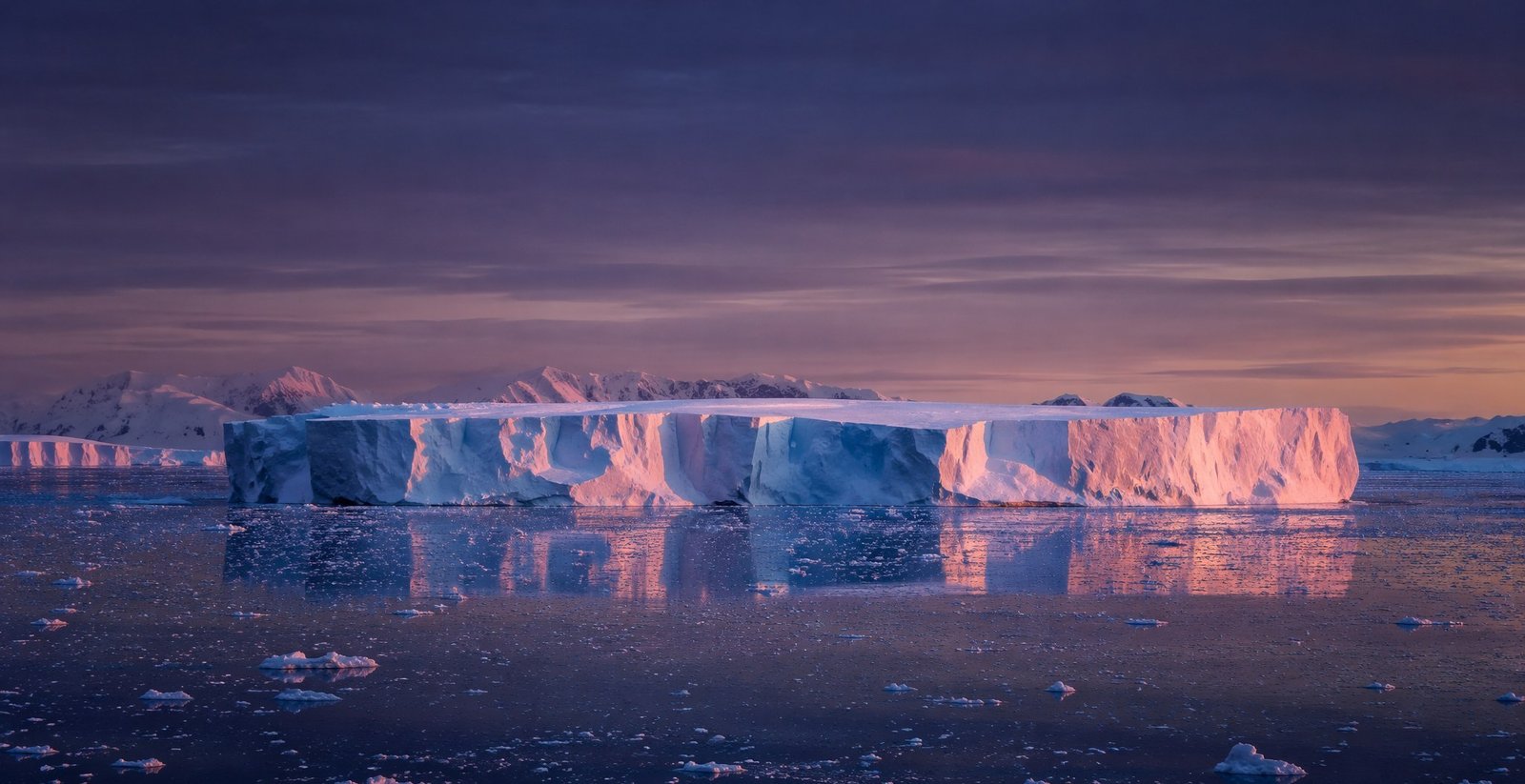
The only continent without a permanent human population, a government, or a city. Antarctica is accessible exclusively by expedition ship from Ushuaia (the Antarctic Peninsula) or Punta Arenas, during the austral summer window of November through March. The Peninsula is the standard entry — temperate enough for zodiacs, close enough for 10-day itineraries, with penguin colonies, icebergs, and the specific silence of a place the world hasn't reached. The Ross Sea is longer, more remote, and categorically less visited; Weddell Sea expeditions access pack ice and the route of Shackleton's Endurance. Vessel choice shapes the entire trip: the 100-guest range (Le Commandant Charcot, Silver Endeavour, Seabourn Venture) offers access, programming depth, and naturalist expertise that 200-passenger ships cannot replicate. Book 12–18 months in advance for December and January departures, which are the warmest and most stable.
Le Commandant Charcot (Ponant) — nuclear-powered icebreaker; High Arctic and Antarctica; the most technically capable luxury vessel afloat
Seabourn Venture — 132 guests; 2 submarines, helicopters, 24 zodiacs; ultra-luxury expedition standard
Silver Endeavour (Silversea) — 100 guests; all-inclusive; the closest comparison to Seabourn at a different price point
Gateway: USH (Ushuaia, Argentina) via EZE Buenos Aires · PUQ (Punta Arenas, Chile) for Ross Sea departures
02
Jun–Aug / Feb–Mar
3–7 days
Svalbard
Arctic Norway · Dual-Season Destination
An archipelago in the High Arctic, 650 miles north of mainland Norway, operating on two entirely separate seasonal logics. In summer (June through August), the midnight sun runs 24 hours and the wildlife is at peak activity: polar bears on the tundra and ice edges, walrus haul-outs on the beaches, reindeer and Arctic fox in the valleys, and seabird colonies of 30,000+ birds on the sea cliffs. In late winter (February through March), the Arctic darkness and the blue polar light create a different world entirely — northern lights visible across a sky with no competing horizon, polar bear tracks on the sea ice, and snowmobile expeditions to the edge of the polar icecap. Longyearbyen, the main settlement (population 2,400), has regular direct flights from Oslo on SAS (2.5 hours) and a small but serious hotel infrastructure that has improved significantly in recent years.
Isfjord Radio Adventure Hotel — converted historic Arctic radio station at the edge of the ocean; the most remote hotel in the Nordic region
Basecamp Spitsbergen (Longyearbyen) — expedition-focused; the original Svalbard lodge; strongest guide team in town
Funken Lodge (Longyearbyen) — restored industrial building; the most comfortable Longyearbyen base for non-expedition travelers
Gateway: LYR (Longyearbyen) direct from OSL · ~2.5 hrs · SAS year-round
03
Year-Round
5–10 days
Iceland
The Accessible Polar Experience
The most accessible polar destination in the world: direct flights from JFK, BOS, MIA, ORD, LAX, SEA, and a dozen other US cities year-round, with Keflavík 45 minutes from Reykjavík. Iceland operates on two seasonal products that attract genuinely different travelers. Winter (September through March) is the northern lights season — Aurora Borealis forecasting has become reliable enough to structure a 3-night trip around a serious sighting. The Golden Circle, the South Coast (Seljalandsfoss, Skógafoss, the black sand beaches at Reynisfjara), and the Jökulsárlón glacier lagoon are all accessible year-round. Summer (May through August) is midnight sun, the Westfjords at their most navigable, whale watching from Húsavík in the north, and puffin colonies on the Snæfellsnes peninsula. The luxury hotel infrastructure is small but serious — The Retreat at Blue Lagoon is the reference property; Deplar Farm in the north is the most remote and design-forward.
The Retreat at Blue Lagoon — 62 suites; attached to the geothermal spa; the definitive Iceland luxury property; book 6–9 months ahead
Deplar Farm (Troll Peninsula) — 13 rooms on a converted sheep farm on a fjord in north Iceland; helicopter skiing, whale watching, northern lights
ION Adventure Hotel (Nesjavellir) — 45 rooms on a lava field near Þingvellir; Aurora Bar with floor-to-ceiling north-facing windows designed for lights viewing
Gateway: KEF (Keflavík) direct from 15+ US cities · Icelandair, United, American year-round
04
Jun–Sep / Feb–Apr
7–14 days
Greenland
The Ice Sheet Destination
The world's largest island, 85% covered by the Greenland Ice Sheet, with a total population of 57,000 spread across settlements connected by helicopter, boat, and dogsled — there is no road network between towns. Summer (June through September) delivers the Ilulissat Icefjord, a UNESCO World Heritage site where Sermeq Kujalleq — one of the world's fastest-moving glaciers — calves icebergs the size of apartment buildings into a 40-kilometer fjord that empties into Disko Bay. The icebergs drift south past the town for weeks after calving; watching them at midnight under continuous daylight is one of the defining visual experiences in polar travel. Winter (February through April) offers dog sledding on sea ice, northern lights over the ice sheet, and the stillest, quietest version of the Arctic. Greenland requires significantly more advance planning than Iceland or Svalbard — flight connections are through Copenhagen or Reykjavík, accommodation is limited, and the serious activities (fjord expeditions, helicopter landings on the ice sheet) require operators booked months in advance.
Arctic Hotel Ilulissat — positioned above the Ilulissat Icefjord; the primary luxury base for ice fjord access; World of Greenland expedition program
Hotel Arctic (Ilulissat) — igloo suites for northern lights; the more design-forward option in Ilulissat; rooftop deck over the fjord
Ilimanaq Lodge (Ilulissat) — 15 rooms; the most intimate property; accessible by boat; no road connection from Ilulissat town
Gateway: GOH (Nuuk) or ILU (Ilulissat) via CPH (Copenhagen) on Air Greenland · or via KEF (Reykjavík) seasonally
05
Best Oct–Mar
14–21 days
South Georgia & Falklands
The South Atlantic Wildlife Circuit
South Georgia is, by most measures, the greatest wildlife spectacle accessible to non-scientist travelers anywhere on earth. Salisbury Plain holds a breeding colony of 400,000 king penguins — a number that makes no intuitive sense until you are standing on a hillside looking down at a crowd of birds that extends to the horizon in every direction. The elephant seal beaches are operational chaos — eight tons of blubber and testosterone, audible from 500 meters, indifferent to your presence. The albatross colonies nest on the cliffs above Grytviken, where the grave of Ernest Shackleton sits in a small cemetery behind the whaling station museum, within sight of the mountains he crossed on foot after losing the Endurance. The Falkland Islands, typically included in South Atlantic circuits, offer rockhopper and Magellanic penguins, sea lion colonies, and striated caracaras — a bird with the intellectual curiosity and complete fearlessness of a crow, which will walk up to your boot and examine it. The entirety of the South Georgia and Falklands experience is lived on board — the same expedition vessels as Antarctica. There are no hotels on South Georgia; the vessel is the accommodation.
Le Commandant Charcot / Silver Endeavour / Seabourn Venture — same vessels as Antarctica; South Atlantic circuits depart Ushuaia Oct–Mar
Ponant, Quark, Aurora Expeditions — mid-range options running dedicated Falklands/South Georgia circuits, typically 14–21 days
Itinerary note: best combined with Antarctica for 21-day circuits; standalone South Atlantic circuits (no Antarctica) run Oct–Nov before the penguin colonies thin
Gateway: USH (Ushuaia, Argentina) via EZE · MPN (Mount Pleasant, Falklands) via Santiago for standalone Falklands access
06
Jun–Sep (Bears/Glaciers)
7–14 days
Alaska
Denali · Katmai · Kenai · Northern Lights
Alaska is the most logistically layered of the six polar regions — it has a functioning road network (the Parks Highway, the Seward Highway), a small number of fly-in wilderness camps that require bush planes, and a coastal zone with glacier fjords and marine wildlife accessible from Anchorage in a half-day. The three distinct Alaska experiences: Interior (Denali National Park, one of the great mountain silhouettes on earth — visible and cloud-free in June and July about 30% of days; Fairbanks for northern lights September through March), Coastal (Kenai Fjords, where tidewater glaciers calve directly into the ocean and the wildlife boat tours out of Seward are among the most productive in North America for orca, humpback, puffins, and Steller sea lions), and Remote Camps (Katmai National Park for brown bears catching sockeye salmon in mid-leap at Brooks Falls, July through September; Ultima Thule Lodge in Wrangell-St. Elias for glacier landings and ski mountaineering). Katmai's Brooks Falls is the most photographed brown bear viewing site in the world and is genuinely accessible — the NPS boardwalk places you 15 meters from the waterfall and the bears are close enough that the camera autofocus locks on fur. The Alaska northern lights season runs September through March from Fairbanks, which has a clearer aurora window than Svalbard or Iceland in most years.
Ultima Thule Lodge (Wrangell-St. Elias) — accessible only by bush plane; glacier landings, ski mountaineering, river rafting; the most remote Alaska lodge
Camp Denali (Denali National Park) — 18-unit wilderness camp with direct views of Denali; 3–7 night stays; guided natural history program
Winterlake Lodge (Iditarod Trail) — fly-in only; the finest kitchen in Alaska backcountry; positioned for northern lights Sep–Mar and heli-skiing Mar–Apr
Gateway: ANC (Anchorage) direct from JFK/LAX/SEA/ORD/DFW · FAI (Fairbanks) for northern lights, connecting via ANC or SEA