

Southeast Asia

One Country,
Three Weather Calendars.

Vietnam runs 1,650 km from the northern border to the tip of the Mekong Delta and carries three climates at the same time, which is why any single-month answer to when to go is wrong somewhere. February through April is the only stretch that works end to end. Everything outside it is a decision about which third of the country the trip is really about — and Angkor and Luang Prabang are two more decisions after that.

Best Season
Feb – April
Best For
Street Food
& Ancient Towns
The Region

Vietnam Holds Three Climates
At the Same Time.

Vietnam runs 1,650 km north to south and carries three climate zones at once, so a single best month does not exist. February through April is the only stretch that works from Hanoi to the Mekong Delta. Central Vietnam keeps its own rain window, September through December, peaking in October and November. End to end needs 13–15 days.

The country's own embassy in Washington puts it at 1,650 km from the northern border to the tip of the Mekong Delta, and about 50 km across at the narrowest point. That shape is the whole planning problem. Hanoi has a cold, damp winter and a wet summer. Da Nang and Hoi An sit under a rain window that belongs to no other part of the country. Ho Chi Minh City runs a straightforward wet and dry calendar. Any answer to "when should I go to Vietnam" that names one month answers for a third of it.

Hanoi and Ho Chi Minh City are not two versions of the same city, and travellers rarely love both equally. Hanoi is older, denser and slower — guild streets still trading by trade, a coffee culture built on egg yolk and condensed milk, and a January that needs a jacket. Ho Chi Minh City is louder, hotter, newer, and better fed at the top end. If the trip holds one city, most first-time visitors belong in Hanoi: the day trips out of it are stronger and the food is more particular to the place.

The add-on question has a clear answer and most itineraries get it backwards. Angkor earns its days: three nights in Siem Reap gives you a 400-square-kilometre archaeological park, and the flight from either end of Vietnam is short enough not to cost a travel day at both ends. Luang Prabang is the harder call. It is a detour rather than a stop: it wants four nights and its own reason, and bolted onto a fortnight in Vietnam it takes more than it returns.

Limestone karsts standing out of the calm water of Lan Ha Bay
Lan Ha Bay · Hai Phong · Vietnam
Where We Send Clients

Six Places Worth the Days They Take

Vietnam is a line rather than a circuit. The order you take these in decides how much of the trip is spent in airports.


Hanoi, Northern Vietnam
Northern Vietnam
Hanoi
The Old Quarter's thirty-six guild streets still run on their trades, and the hour that matters is before seven, when the pavement kitchens are working and the scooters have not taken the road. Bún chả for breakfast, egg coffee up an unmarked staircase, the lakes doing the job of a town square.
Old Quarter Street Food Lake Mornings
Explore →
Ha Long & Lan Ha Bay, Quang Ninh & Hai Phong
Quang Ninh & Hai Phong
Ha Long & Lan Ha Bay
UNESCO's 2023 extension brought the Cat Ba Archipelago into the same property, so Lan Ha is not the cheap version of Ha Long — it is the quieter half of one listed site of 1,133 islands and islets. Ha Long's main channel takes the day-boat traffic; Lan Ha, from Hai Phong, takes a fraction.
Limestone Karst Overnight Boat Cat Ba
Explore →
Hue, Central Vietnam
Central Vietnam
Hue
The Nguyen dynasty capital from 1802 to 1945, and the one coastal city that repays a guide rather than a map. The Citadel, the Forbidden Purple City and the Perfume River tombs are a single World Heritage complex, and much of what stands was rebuilt after 1968. Two nights, then the Hai Van Pass south.
The Citadel Royal Tombs Hai Van Pass
Explore →
Hoi An, Quang Nam
Quang Nam
Hoi An
Thirty hectares of fifteenth-to-nineteenth-century trading port that never got redeveloped, which is why UNESCO listed it in 1999. The tailors are real and want two fittings, not one. The Thu Bon River that made the town rich floods the Ancient Town most years, mid-October to mid-November.
Ancient Town Tailoring Thu Bon River
Explore →
Ho Chi Minh City & the Mekong, Southern Vietnam
Southern Vietnam
Ho Chi Minh City & the Mekong
The commercial engine, and the better half of the country to eat expensively in. District 1 for the colonial-era spine, District 4 and Cholon for what people actually eat. The Cu Chi tunnels want a guide who has read widely rather than a script. The Mekong Delta wants a night, not a day trip.
District 1 Cu Chi Mekong Delta
Explore →
Siem Reap & Angkor, Cambodia
Cambodia
Siem Reap & Angkor
Four hundred square kilometres of archaeological park, inscribed by UNESCO in 1992 and far larger than the one temple on the postcard. Angkor Wat at sunrise is worth the alarm once. The Bayon and Ta Prohm repay the second morning; Banteay Srei's carving earns a third day.
Angkor Wat The Bayon Banteay Srei
Explore →
Featured Itineraries

Trips We Plan Often

Built around the internal flights that keep the driving honest, the bay boats worth a night aboard, and add-ons chosen for the days they actually earn.
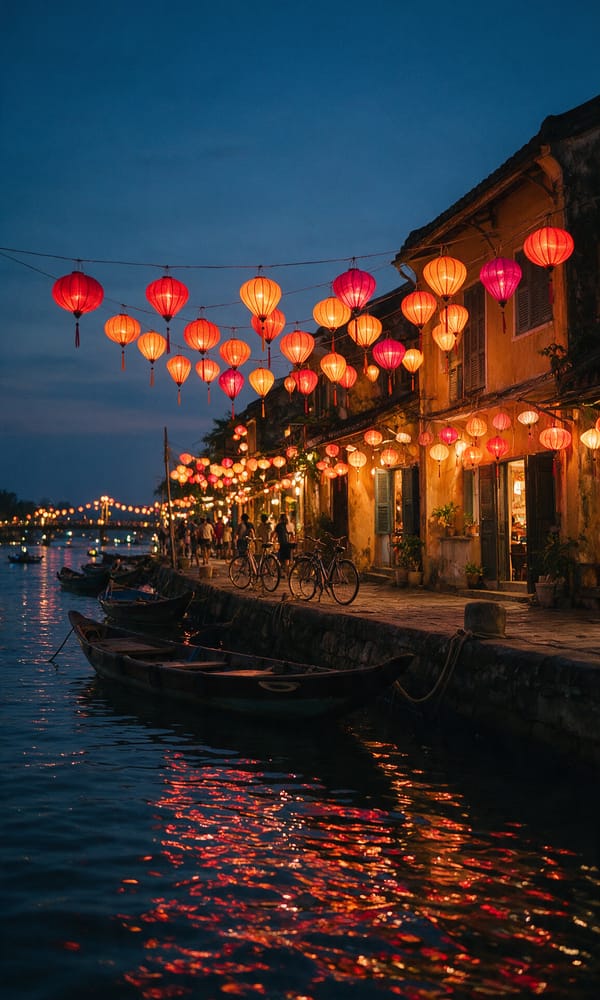

Silk lanterns strung above ochre shophouses and moored sampans on the Hoi An riverfront at dusk
February – April · 13–15 Days
Vietnam, North to South
The full line, sequenced so the weather works rather than the map. Three nights in Hanoi — the Old Quarter before seven, a day out to the limestone and river caves at Ninh Binh, and one left loose for jet lag. Two nights aboard a boat in Lan Ha Bay rather than a day trip from Ha Long. Fly to Da Nang for Hue, the royal tombs and the Hai Van Pass, then three nights in Hoi An with the tailor booked on arrival so a second fitting fits. Fly south for two nights in Ho Chi Minh City and one in the Mekong Delta, which wants a night rather than an excursion. Three internal flights, no overnight train unless you want one.
Vietnam13–15 Days
Plan This Trip
A wooden sampan rowed between sheer limestone karst towers on the river at Ninh Binh
October – April · 9–11 Days
The North, Slowly
Northern Vietnam on its own, for travellers who would rather go deep than long. Four nights in Hanoi as a base: the guild streets and the lakes, a food walk that starts at a pavement stall rather than a restaurant, and the museums that explain the twentieth century better than any single site. Two nights at Ninh Binh for the karst that Ha Long has underwater and this has standing in rice fields. Two nights on a small boat in Lan Ha Bay, with kayaks and an anchorage the day boats never reach. Finish in the mountains north-west of Hanoi if the season allows. No internal flights at all, which is most of the point.
Vietnam9–11 Days
Plan This Trip
Strangler fig roots pouring over a carved sandstone gallery wall at Ta Prohm in Angkor
February – April · 15–17 Days
Vietnam and Angkor
The north-to-south run above, then a short flight west to Siem Reap for three nights. Angkor Wat at sunrise on the first morning — once, and never again at that hour — followed by the Bayon and Ta Prohm at the hours when the coaches are elsewhere, and a third day for Banteay Srei and the temples beyond the main loop. The park covers 400 square kilometres and holds dozens of monuments; two nights is a highlight reel, three is a visit. Finishing in Cambodia rather than opening there also puts the hardest travel days at the front, while everyone still has the legs.
Vietnam & Cambodia15–17 Days
Plan This Trip
Saffron-robed monks walking away down a misty Luang Prabang lane past kneeling almsgivers at dawn
November – March · 12–14 Days
Central Vietnam and Luang Prabang
For a second trip, or a first that wants two countries rather than one country's whole length. Two nights in Hanoi, four split between Hue and Hoi An, then a flight to Luang Prabang for four more. The Lao town can be walked in an afternoon and still rewards four nights: the dawn alms round, the Mekong at the end of the day, the waterfalls an hour out, and the hours in between when nothing is scheduled. UNESCO listed the town in 1995 for the way its Lao and French layers occupy the same streets. This is for people who have already run a country end to end and did not enjoy the pace.
Vietnam & Laos12–14 Days
Plan This Trip
Why Plan With Us

What We Add to Vietnam Planning

The destination where the calendar does more damage than the budget, and where the decisions that shape the trip are the ones you cannot research from a screen.

⬡
Three Calendars, One Itinerary
A Vietnam trip rarely goes wrong on a hotel. It goes wrong by running the country in the wrong direction in the wrong month. Start in Hanoi in early November and work south and you meet central Vietnam at the peak of its rain, which nothing on the ground can fix. The same route in March meets none of it. We fix the order and direction against the month you can travel, then choose properties inside that. Where the month is fixed and wrong for all three regions, we say which third to cut.
⬡
The Bay Is a Boat Decision
Nobody remembers which bay they were in. They remember the boat, how many other people were on it, and whether the anchorage was quiet at six. That makes this a boat decision, and the boat market is genuinely hard to read from photographs: cabin counts run from four to forty, one operator name can cover three tiers of vessel, and the route decides whether you wake in a channel full of engines or a cove with nothing in it. It is one of the few places where a call to someone who has been aboard changes more than any hotel choice.
⬡
Guides Who Answer Follow-Ups
Vietnam's twentieth century is on the itinerary whether you schedule it or not — the Citadel at Hue, the Cu Chi tunnels, the museums in Ho Chi Minh City. The gap between a guide working from a script and one who has read widely and will take a hard follow-up question is enormous, and it is not something a booking form lets you request. The same holds at Angkor, where a guide trained in the archaeology turns a temple into the hydraulic city it belonged to. These are named requests, made months ahead.
⬡
Which Add-On Earns the Days
Angkor earns them. Luang Prabang usually does not, and you should hear that before you book. Siem Reap sits a short flight from either end of Vietnam, and three nights there is a second destination rather than an errand. Luang Prabang is farther, slower to reach, and worth four nights when it gets them — bolted on for two at the end of a fortnight it costs a travel day at each end and gives back an afternoon. Wanting both honestly means three weeks. If the trip is two, pick one and do it properly.
When to Go

Vietnam by Season

The Whole-Country Window
February – April
The one stretch where north, centre and south are all workable at once. Hanoi is warming and mostly dry, the central coast sits between its rain windows, and the south is still in its dry season. That is why every north-to-south itinerary here carries these months. It is also the busiest window: the good bay boats and the Hoi An tailors commit earliest, so a March trip is a decision made the previous autumn. Tet, the Lunar New Year, falls in late January or February depending on the year and wants planning around rather than through.
Best Overall Window
Central Coast Summer
May – August
The best months for the beaches at Da Nang and Hoi An, and the worst for walking anywhere at midday. The centre is dry and bright; the north is hot and humid with afternoon storms; the south is in its wet season, which usually means a heavy hour rather than a lost day. This is the window for a trip built on the central coast rather than the country's full length. Rates sit below spring and the bays are quieter, at the price of the heat and a storm risk rising from August.
Central Rain, Northern Winter
September – January
Months to plan around rather than write off. Central Vietnam's rain runs September through December and peaks in October and November, when the Thu Bon River backs into Hoi An's Ancient Town in most years. Vietnam's national forecaster issues the storm warnings worth watching, rather than a ten-day phone forecast. Meanwhile the north is cool and dry and at its best, and the south dries out from December. A trip held to Hanoi and the bay works well here. A north-to-south run does not.
Ready When You Are

Plan a Vietnam Trip
Around the Month You Have

Tell me your dates, whether you want the whole country or one third of it done properly, and whether Angkor or Luang Prabang is on the list. I'll come back with a specific itinerary, the bay boat I'd put you on, and the guides I'd use in each city — within one business day.

Plan a Vietnam Trip All Asia Destinations

No booking fees  ·  Response within 24 hours  ·  Fully bespoke

What It Costs

What Vietnam Actually Costs

Priced as separate country legs, not one nightly rate
Vietnam, Cambodia and Laos price in three separate currencies with their own visa regimes and site fees, so one nightly figure would average a Hanoi hotel against an Angkor pass and describe neither.
What actually sets the number
  • Cabin count on the bay boat — four berths and forty berths are different products
  • Whether Cambodia is on the route — Angkor's three-day pass is $62 a person before the flight
  • The February-to-April window, the only stretch that works from Hanoi to the Mekong Delta at once

Tell me the dates and the party and you get a real quote, not a range. Source: Angkor Archaeological Park pass prices.

Common Questions

Vietnam & Southeast Asia — FAQ

The questions that come up most when planning a first Vietnam trip — which month, how long the country really needs, which bay, and whether Angkor and Luang Prabang earn their days.

February through April is the only window that works from Hanoi to the Mekong Delta at the same time. The north is warming and mostly dry by February, the central coast sits between its rain windows, and the south is still in its dry season. Every other month favours one region and works against another, which is why a single-month answer to this question is usually wrong. October through April is right if the trip stays north. May through August suits a trip built on the central coast. Where the dates are fixed and bad for all three, cut a region rather than run the whole line badly.

Thirteen to fifteen days, with three internal flights. Eleven is possible and produces a trip of packing and unpacking; nine is a highlight reel. The workable shape is three nights in Hanoi, two aboard a boat in the bay, two around Hue, three in Hoi An, two in Ho Chi Minh City and one in the Mekong Delta, with flights placed so no good morning goes to an airport. Shortening rarely means dropping a place — it means dropping the second night everywhere, and Vietnam punishes that harder than most countries, because so much of what is good here happens before seven.

Lan Ha, for almost everyone, because it is the same World Heritage property with a fraction of the boat traffic. UNESCO's 2023 extension brought the Cat Ba Archipelago into the listing, now 65,650 hectares and 1,133 islands and islets as Ha Long Bay – Cat Ba Archipelago. Lan Ha sits inside it, reached from Hai Phong rather than the Ha Long cruise port, and its anchorages are quieter. The exception is a traveller who wants the show caves and the large-vessel comfort only the main channel offers. Either way, the decision that matters is the boat: cabin count, route, and where it anchors overnight.

Yes, and the Ancient Town itself floods in most years between mid-October and mid-November. Central Vietnam's rain window runs September through December and peaks in those two months — a separate calendar from both the north and the south, and the most misunderstood fact about Vietnamese weather. The Thu Bon River that made Hoi An a trading port also backs into its streets, and the listed core sits at the low point. It does not make the town unvisitable. It does make non-refundable bookings a bad idea in that window, and it is the wrong time to start tailoring that needs two fittings.

Most visitors need one for each country, and each runs its own official e-visa portal. Vietnam's e-visa is open to every nationality for stays of up to 90 days, single or multiple entry, and is applied for on the government portal rather than the lookalike sites that outrank it. Cambodia and Laos run their own systems, at evisa.gov.kh and laoevisa.gov.la. Eligibility, validity and passport-expiry rules change, so check the official portal for your nationality alongside your own government's current advice — travel advisories for US travellers. Rules verified ; confirm before booking flights.

Yes, and three nights in Siem Reap is the right number rather than two. The archaeological park UNESCO inscribed in 1992 covers roughly 400 square kilometres and holds dozens of monuments. Two nights buys Angkor Wat at sunrise and a rushed loop; three buys the Bayon and Ta Prohm when the coaches are elsewhere, plus a day for Banteay Srei and the outer temples. The flight from either Hanoi or Ho Chi Minh City is short, which is what makes this work where a longer hop would not. Take it at the end rather than the middle.

Only if you can give it four nights and drop something else to find them. Luang Prabang is one of the loveliest towns in Asia — listed by UNESCO in 1995 for the way its Lao temples and French colonial streets share the same blocks — and a detour rather than a stop. Two nights bolted onto a full-length Vietnam itinerary costs most of a travel day at each end and returns an afternoon. It works as the second half of a shorter trip paired with Hanoi and central Vietnam, or on its own with northern Laos. Vietnam end to end plus Angkor plus Luang Prabang is a three-week trip.

Hanoi, for most first-time visitors, because the day trips out of it are stronger and the food is more specific to the place. Hanoi is older and denser, the Old Quarter still runs on its guild streets, and the bay, Ninh Binh and the northern mountains all sit within reach. Ho Chi Minh City is the better city to eat expensively in, the better base for the Mekong Delta, and where the commercial energy actually is. Travellers who want a working modern Asian city usually prefer it; those who came for the older Vietnam usually do not. Worth settling before the itinerary rather than after.
More questions answered on the Full FAQ Page
From the Journal

Read More on Planning Asia